Tag Archives: investigative journalism

Investigative journalism’s AI challenges: accuracy and bias, explainability and resources

screenshots of guidelines on AI

Having outlined the range of ways in which artificial intelligence has been applied to journalistic investigations in a previous post, some clear challenges emerge. In this second part of a forthcoming book chapter, I look at those challenges and other themes: from accuracy and bias to resources and explainability.

Continue reading

AI in investigative journalism: mapping the field

screenshots of various examples of AI being used in journalism, including Serenata de Amor, Leprosy of the Land and The Implant Files

Investigative journalists have been among the earliest adopters of artificial intelligence in the newsroom, and pioneered some of its most compelling — and award-winning — applications. In this first part of a draft book chapter, I look at the different branches of AI and how they’ve been used in a range of investigations.

Continue reading

VIDEO: How to plan an investigation or large editorial project

Planning an investigation, or any larger editorial project, raises its own particular challenges — but if you know where to look, you can find resources that are especially useful in anticipating and tackling those.

This video, made for students on the MA in Data Journalism at Birmingham City University, introduces and explores two such resources: Mark Lee Hunter‘s story-based inquiry method; and breaking down an investigation into five roles; . It also touches on issues to consider in undercover reporting or the use of subterfuge.

Further video clips of Mark Lee Hunter and Luuk Sengers are embedded below:

Continue reading

Developing persistence and tenacity as a journalist (7 habits of successful journalists part 3)

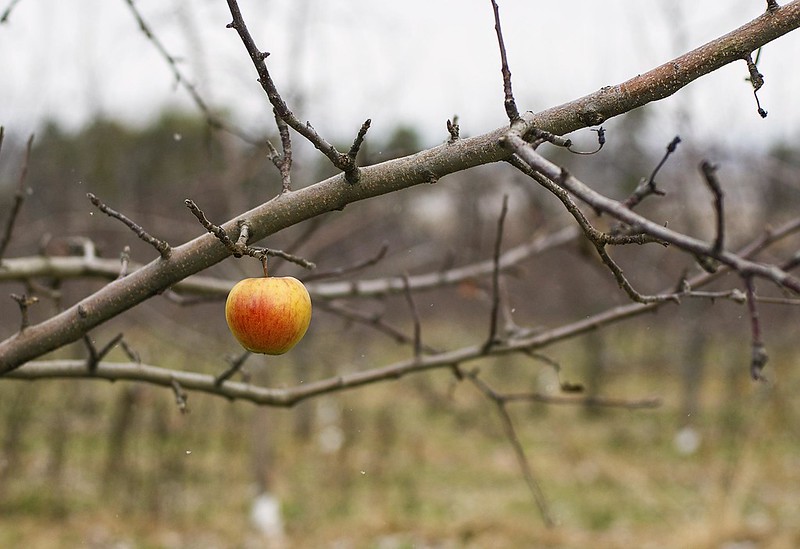
Apple alone on bare tree. Image by Rodger Evans
Tenacity image by Rodger Evans

In the third of a series of post on seven habits often associated with good journalism I look at how persistence and tenacity can be taught in journalism training — and why it should be.

One of the earliest skills that broadcast journalists learn is how to conduct a vox pop. The vox pop is an attempt to ‘take the pulse’ of the public on a topical issue: the journalist will stand in a busy public place and ask passers-by to share their thoughts on the issue of the day.

The results will typically be used as part of a news package (not, it should be pointed out, as a standalone story), particularly when the news story in question doesn’t have many other interviews or visuals to draw on. Most are quickly forgotten. Continue reading

Longform writing: how to avoid the ‘saggy middle’ — and end strongly

4 ways to structure a longform story

This year on my MA in Data Journalism and MA in Multiplatform and Mobile Journalism I have been teaching students how to plan and organise a longform story. Having already written about story types that can help organise an investigation and beginnings, in this post I want to look at techniques for organising the middle of longform features — and how to wrap it all up at the end.

Middles and endings of long features are no less tricky than the beginnings you can spend so much time writing and rewriting. Often people fall back on particular habits which may not quite ‘work’ for the story being told.

Telling a story in chronological order, for example, is not always the most effective approach. Stories where the action is not equally dispersed chronologically can ‘sag’ in these cases and the momentum of a strong beginning get lost.

In those situations a storyteller with a varied toolbox might use places, or themes, or scenes, to keep that momentum going instead. Continue reading

Longform writing: how to write a beginning to hook the reader

7 ways to begin a longform story: person, place, action, detail, question, problem, revelation

Previously I’ve looked at 7 story types that can help organise an investigation and the 5 stages of a longform story. In this follow-up post (taken from a class in my MA in Data Journalism and MA in Multiplatform and Mobile Journalism) I look in more detail at the editing process once you have a longform story laid out — specifically, how to start that long feature.

Beginnings are notoriously tricky for any writer. For news reporters the advice is simple: start with the ‘new’ thing in your story, and make sure there is a verb in there: a person has said something; a report has revealed something; authorities are looking for someone, warning about something, planning to do something; and so on.

But in longform and feature writing the approach is more subtle. Although we can choose to report that something has been ‘revealed’ right at the start, this risks removing tension from the story and leading the reader to abandon it before they have the full picture.

Instead, then, journalists use a number of techniques to keep the reader engaged across a longer format — with the important implied promise that the story is going to be worth it.

So, for anyone struggling to think of a way to start a longer story — or feel that you can improve the approach you’ve chosen — I’ve pulled together seven types of beginning that are used in longform reporting and feature writing, with some considerations to bear in mind — and plenty of examples. Continue reading

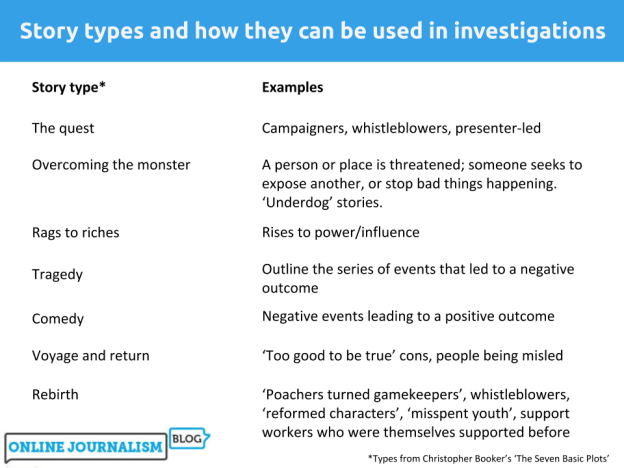
Here are 7 story types that can be used to help organise investigations

7 story types and investigations

This year I’ve been working with my MA Data Journalism and MA Multiplatform and Mobile Journalism students on techniques for telling longer form stories. In this post I explain how a consideration of seven common plot types can help you clarify what story it is you’re telling – and what you might need to tell that.

There are many ways to tell a story, and many stories to tell. An investigation can be trying to establish the cause of a problem, or solutions to that problem; it can be revealing previously hidden unethical behaviour, or shining a light on issues which are ‘hidden in plain sight’; it can be holding a mirror up to a part of society to reveal its scale; or giving a voice to that part of society as a step towards a more sophisticated understanding of problems affecting it. And depending on the type of story, you might adopt different approaches to telling it. Continue reading

Emma Youle: “Local newspapers are one of the best places to do in-depth investigations because they are very well connected to the community”

emma youle

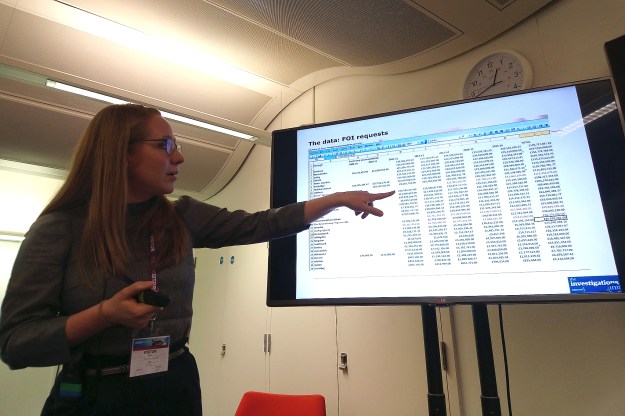
Emma Youle speaking at the Data Journalism UK conference in 2017 – photo by Wan Ulfa Nur Zuhra

As Archant’s award-winning Emma Youle announces she is to leave local newspapers to join Huffington Post UK as a special correspondent. Victoria Oliveres spoke to the investigative journalist about setting up local investigations, using data, and campaigning.

If you’ve looked at any UK journalism awards ceremony in the last few years, chances are you will have seen Emma Youle’s name: winner of the Private Eye Paul Foot Award in 2017, and the Weekly Reporter of the Year at Regional Press Awards 2016, she has also been shortlisted in many others, largely for her approach to showing the impact of national decisions at local level.

This success has come after a career of over a decade in journalism, including the last three years as part of Archant‘s investigations unit, where she uncovered in-depth stories from London boroughs.

Setting up local investigations

The unit was set up in 2015, which Youle considers to be quite pioneering at the time.

“I think local newspapers are one of the best places to do in depth investigations because they are very well connected to the community,” Emma says. Continue reading

Announcing the line up for Data Journalism UK 2017

The Bureau Local's Megan Lucero

The Bureau Local’s Megan Lucero

We’ve confirmed the line up for this year’s Data Journalism UK conference on December 5 — and I’m pretty excited about it.

We’ve managed to pack in networked data journalism and investigations, automation and the internet of things, and some practical sessions too, with my new MA Data Journalism students pitching in to help.

Tickets are available here including early bird and afternoon-only options, but you’ll need to be quick — the event sold out last year.

Here’s more detail on the running order… Continue reading

Here’s the thinking behind my new MA in Data Journalism

A few weeks ago I announced that I was launching a new MA in Data Journalism, and promised that I would write more about the thinking behind it. Here, then, are some of the key ideas underpinning the new course — from coding and storytelling to security and relationships with industry — and how they have informed its development. Continue reading