Category Archives: newspapers

Online journalism atlas: Iceland (by Liz Bridgen)

In the latest part of the Online Journalism Atlas, Liz Bridgen looks at the online media scene in Iceland. Got any information about your own country’s online journalism? Add it here.

As the country with the world’s deepest penetration of internet use (86.3% of the population) and highest literacy rate (around 99%), it’s no surprise that Iceland should have a buoyant online media scene.

The print, broadcast and online environment

Iceland’s population of just over 300,000 have a choice of three national Icelandic-language newspapers – all with online editions – plus several domestic English-language titles aimed dually at tourists and the growing útlendingur (foreigner) population. Continue reading

Interview with the editor of the Público website

Alex Gamela talks to António Granado, editor of the online edition of Público, a reference newspaper in Portugal, as they relaunch their website.

António Granado Público have always been ahead as far as online presence is concerned, and recently the newsroom created a video team, as well as launching a redesigned website. In this short interview, we tried to ask a very busy António about his views on online journalism, a subject he discusses in his blog PontoMedia. Granado is also a lecturer at Universidade Nova de Lisboa, and is one of the best Portuguese minds dealing with the new media issues. Continue reading

Another source of inspiration for journalism (Bas Timmers)

Guest Blogger Bas Timmers is Newsroom Editor at Dutch broadsheet de Volkskrant.

‘A newspaper is like an oil tanker,’ editors in chief call out in despair again and again. Changing the direction is often slow and difficult. But that of course just depends on whether you have the right rudder or not. Because the captain is still steering the ship. Yes, journalists can be quite nasty and stubborn, but mutiny is still a step too far for most of them.
Continue reading

Washington Post Facebook app – the sequel

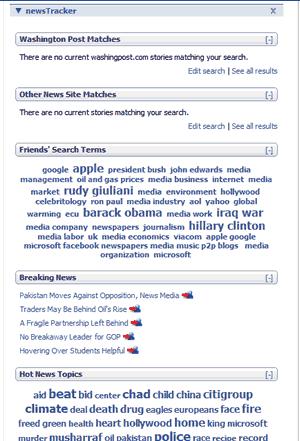
Washington Post Facebook appThe Washington Post have followed up their playful Facebook app Compass with the more functional newsTracker – and it’s very good indeed.

Not only can you specify which topics you want ‘fed’ to your page – but you can also include custom searches (which is why mine has no current matches – they’re very specific).

The ‘Hot News’ tag cloud is nice – but the ‘Friends’ Search Terms’ really takes advantage of the social element of Facebook technology – although it does raise possible privacy issues (Blog Friends does a similar thing very well).

Add the application here.

Read Rob Curley’s blog entry on the tool here.

All quiet on the western front? Not quite.

German regional publisher WAZ just launched its new flagship website, Der Westen. New features include geotagging, blogs and keyword filtering, monitored from a futuristic-looking newsroom. Martin Stabe has the details.

The concept, writes Der Spiegel, is to let users choose the centre of their world, their perspective on news. Der Westen then provides content around it.

The FAZ today has an interview of blogger-turned-editor-in-chief Katharina Borchert. Numerous online ventures have been playing on regional papers’ turf, from local advertisers flocking to AdSense to local radios breaking news more rapidly, she says. To compete, paper brands must regain their offline roles as community leaders by enhancing the news hole with social features, Facebook-style. Continue reading

Do you work in newspaper video journalism?

Andy Dickinson is conducting a short survey to gather information about how video is produced in newspaper newsrooms and who does it. The results will be made available on his blog – www.andydickinson.net.

Sounds like a great idea – it’s a one-page job so quick to fill out. Fill out the survey here.

Blogs and Investigative Journalism: sourcing material

The third part of this draft book chapter (read part one here and part two here) looks at how blogs have changed the sourcing practices of journalists – in particular the rise of crowdsourcing – and provided opportunities for increased engagement. I would welcome any corrections, extra information or comments.

Sourcing material

While the opportunity that blogs provide for anyone to publish has undoubtedly led to a proliferation of new sources and leads – particularly “Insider” blogs produced by experts and gossips working within particular industries (Henry, 2007) and even ‘YouTube whistleblowers’ (Witte, 2006) – it is the very conversational, interactive and networked nature of blogs which has led journalists to explore completely new ways of newsgathering. Continue reading

Katine: Guardian does something very special indeed with crowdsourcing

If you have ten minutes today, click along to Katine: it starts with a village. With this project The Guardian is doing something very special indeed with crowdsourcing, interactive storytelling, and journalism itself.

Launched over the weekend, Katine appears to be a new approach to “the annual appeal to focus attention on worthwhile causes during the pre-Christmas giving season”. Editor Alan Rusbridger explains: Continue reading

Event: Notes from the digital news frontline (Preston, UK)

One for the diary: The latest Journalism Leaders Forum from the University of Central Lancashire in Preston is on the theme ‘Local Turf Wars – Notes from the digital news frontline’ Continue reading

The burden of a paper image (Bas Timmers)

Bas Timmers is Newsroom Editor at Dutch broadsheet de Volkskrant. This post is also available at http://www.bastimmers.nl/diginewsuk.php

“In the virtual world a year only lasts three months,” a manager once sighed. The innovations keep on coming very quickly indeed on the web, and a success story can turn into a tale of shattered dreams within months. Kazaa and ICQ were once extremely popular, for instance, but are now only marginal players on the web.

This high speed of innovation doesn’t mean that you cannot draw any lessons from the past. For example, Pablo J. Boczkowski was examining three online projects at American newspapers already in 1999 and 2000, but the conlusions he drew are still applicable. Continue reading