Category Archives: online journalism

Civio and transparency in Spain: “We fight for public access to data”

Javier de la Vega

Javier de la Vega

Spanish citizens are now a step closer to understanding how power operates in the country, and how decisions affect them, thanks to the work of organisations like Civio fighting for transparency and access to public data. In October their work was recognised with the Gabriel Garcia Marquez award in innovative journalism for their investigations Medicamentalia. In a guest post for OJB, Nuria Riquelme Palazón spoke with Javier de la Vega, one of the members of Civio.

Access to public information, accountability and participatory democracy may have been a reality in many countries for some time — but in Spain they sounded like a utopia. Entrepreneur Jacobo Elosua and computer technician David Cabo decided that this had to change.

The pair used their savings to build an organisation with the intention of serving those active citizens who, like them, believed in transparency: Civio Foundation.

Taking inspiration from organisations like mySociety in the UK, Ciudadano Inteligente in Chile and the Sunlight Foundation in the USA, they began the long process in 2011. Continue reading

Civio y el poder de la transparencia: “Luchamos por el libre acceso a la información en España”

Javier de la Vega

Javier de la Vega

La ciudadanía española se encuentra un paso más cerca de saber como su gobierno y sus políticos hacen qué, cuándo, por qué y, lo más importante, cómo todo esto les afecta. Y este logro ha sido posible gracias al incesante trabajo de organizaciones como Civio, que lucha por una transparencia real y el libre acceso a la información. El esfuerzo de este equipo fue recompensado el pasado octubre con el premio Gabriel García Márquez en Innovación por una de sus últimas investigaciones: Medicamentalia. Nuria Riquelme Palazón ha hablado con Javier de la Vega, uno de los integrantes de Civio.

Acceso a la información pública, rendición de cuentas, democracia participativa… términos que en países como Reino Unido son una realidad desde hace tiempo, en otros como en España sonaban a una utopía descabellada, y esto tenía que cambiar.

Y el cambio empezó cuando Jacobo Elosua (emprendedor) y David Cabo (informático)  juntaron sus ahorros para construir una organización bajo el servicio de aquellos ciudadanos que, como ellos, creen en la transparencia: la Fundación Civio.

Continue reading

Whatever happened to the audio slideshow?

Remember the audio slideshow? Once one of the most compelling editorial formats – and a truly web-native one at that – it is now rare to see them on a news website. And a whole wave of audio slideshow work is starting to disappear from the web.

The page for BBC’s Jazz junctions – riding New York’s A Train now lacks the audio slideshow it once held, while The Guardian is awash with pages showing gaps where a slideshow should be – like After the riots and Timbuktu’s ancient manuscripts (both from 2007), error messages about Flash (from 2010 and 2011) – or no pages at all in the case of Shrimp fishing in the Wash or Somalia’s refugee camps.

audio-slideshows-chart new-york-times

A search on the New York Times Chronicle tool shows a spike in mentions of audio slideshows at the end of the last decade. After 2010 they aren’t mentioned at all.

2012 seems to have been the last time audio slideshows were part of the fabric in the UK: most of the work on the Guardian’s Audio Slideshows section is from that year, while it represents the peak of production at the BBC. Here’s just a selection: Continue reading

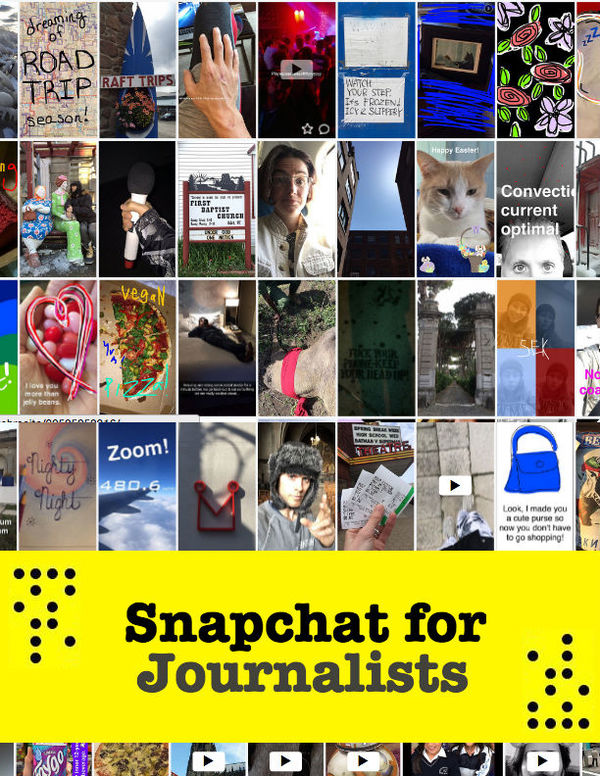
Snapchat para periodistas: una guía pensada para la redacción

spanish-screenshots-snapchat

¿Cómo producir contenido noticioso para Snapchat? ¿Es posible calcular estadísticas de audiencia? ¿Qué sentido tiene invertir recursos y tiempo en producir contenido que va a desaparecer en 24 horas? Estas y otras preguntas aparecen respondidas en “Snapchat para periodistas”, una guía que detalla cada uno de los recursos de esta red social y cómo aprovecharlos en estrategias de publicación.

El libro, escrito por el periodista y profesor británico Paul Bradshaw, incluye muchos ejemplos de las cuentas de Snapchat de medios de Estados Unidos y Reino Unido, como el Huffington Post, la BBC, The New Yorker, CBS, Fusion y Mashable, entre otros.

La traducción al español incluye algunas capturas de pantalla de canales de medios latinoamericanos, además de las del original. Aunque el uso de Snapchat no está tan extendido en redacciones de habla hispana, hay algunos medios que mantienen cuentas, como Perú 21 y Todo Noticias (Argentina).

Además de ilustrar buenas prácticas, los ejemplos también documentan una parte de la historia de los usos de la plataforma –que puede ser útil especialmente para quienes no lleven mucho tiempo usándola.

El texto cubre todas las opciones técnicas (grabación de video y sonido, edición de texto, uso de lápices y filtros, etc.); estrategias de producción y diseño narrativo; almacenamiento de estadísticas de audiencia; algunos consejos útiles para construir una red de amigos; y otras funcionalidades más sofisticadas para usuarios avanzados.

Paul Bradshaw es autor de varios libros sobre periodismo, incluyendo otros dos disponibles en español: “Excel para periodistas” y “Periodismo de datos: un golpe rápido”.

My online journalism Masters course is changing its name. Here’s why

telegraph-newsroom image by alex-gamela

MA student Alex Gamela took this image of the Telegraph newsroom during the first year of the MA

My MA in Online Journalism has a new name: the MA in Multiplatform and Mobile Journalism*. It’s still a course all about finding, publishing and distributing journalism online. So why the name change?

Well, because what ‘online‘ means has changed.

For the last 18 months I’ve been talking to people across the industry, reflecting on the past 7 years of teaching the MA, and researching the forthcoming second edition of the Online Journalism Handbook. Here, then, are the key conclusions I arrived at, and how they informed the new course design:

1: Adapting to new platforms is a specific skill

In the last few years a significant change has taken place. Journalism is now increasingly ‘native’, playing to the strengths of multiple platforms rather than just using them as promotional ‘channels’. It went from web and social to chat, keeps remembering email, and in the near future will take in cars, the home and other connected devices too. Continue reading

See all the presentations from Data Journalism UK 2016

If you enjoyed the first Data Journalism UK conference on November 22, or followed from afar, I’ve gathered together all the presentations from the day on a special Slideshare account here.

The BBC’s Dan Wainwright has written about his session on data journalism on this blog, Anna Noble wrote about some of her work on The Information Lab, there’s a brief summary in the Media Mill email newsletter here, and you can also read a write-up of the event by Benjamin Cooley on Journalism.co.uk:

We’re already starting to plan ahead for Data Journalism UK 2017, so if there are sessions or people you’d like included, please let me know in the comments or on Twitter.

7 platforms who became publishers in 2016

We've got work to do

In 2016 Tumblr got angry

If there was always a suspicion that it would happen eventually, this year it was confirmed: in 2016 platforms from Facebook to Snapchat, Twitter to Tumblr, all took significant steps towards becoming fully blown publishers. Here are 7 things that happened this year that swung it. Continue reading

How the BBC England data unit scraped airport noise complaints

heathrow-noise-story

This news story used scraping to gather data on noise complaints

BBC England Data Unit’s Daniel Wainwright tried to explain basic web scraping at this year’s Data Journalism Conference but technical problems got in the way. This is what should have happened:

I’d wondered for a while why no-one who had talked about scraping at conferences had actually demonstrated the procedure. It seemed to me to be one of the most sought-after skills for any investigative journalist.

Then I tried to do so myself in an impromptu session at the first Data Journalism Conference in Birmingham (#DJUK16) and found out why: it’s not as easy as it’s supposed to look.

To anyone new to data journalism, a scraper is as close to magic as you get with a spreadsheet and no wand. Continue reading

Telegram launches chat-optimised format – and an anonymous CMS

Chat app Telegram was ahead of the curve on bots – has it just kicked off another race to create chat-optimised publishing formats?

Instant View, launched overnight, is Telegram’s answer to Facebook’s Instant Articles (added to Messenger in July), Google’s AMP and Apple News: a way for publishers to make sure content loads quickly.

For now it’s only being used by publications using Medium, and TechCrunch, but the announcement promises:

“Eventually we want to provide Instant View pages for every story on the Web”

If you’ve watched the shifts in user behaviour from web to social, and then from social to chat, you can see what might be coming next: another battle to optimise for where the eyeballs are.

telegram-instant-view-optimised-for-chat

This is what an Instant View article looks like within the Telegram app

…And an anonymous publishing platform

As well as announcing its new article format Telegram has launched an anonymous publishing CMS: Telegra.ph.

One of Telegram’s major selling points is its security and Telegra.ph is a perfect extension to that.

I’ve used the new CMS to write more about how it works.

Too many election tweets? Some simple Tweetdeck techniques for filtering the information overload

election2016-hashtags

Tonight many journalists will have Tweetdeck or similar social media dashboards ‘tuned in’ to coverage of the US election, typically by creating columns to monitor activity on key hashtags like #Election2016. But on a big occasion like this, the volume of tweets becomes unmanageable. Here then are a few quick techniques to surface tweets that are likely to be most useful to reporters:

Picking the right hashtags: Hashtagify

Hashtagify is a tool for finding out the popularity of certain hashtags. Type a tag into the search box and you’ll get a network diagram like the one shown above — but you can also switch to ‘Table mode’ to get a list of tags that you can sort by popularity, correlation, weekly or monthly trend. Continue reading