Tag Archives: ICIJ

Investigative journalism’s AI challenges: accuracy and bias, explainability and resources

screenshots of guidelines on AI

Having outlined the range of ways in which artificial intelligence has been applied to journalistic investigations in a previous post, some clear challenges emerge. In this second part of a forthcoming book chapter, I look at those challenges and other themes: from accuracy and bias to resources and explainability.

Continue reading

AI in investigative journalism: mapping the field

screenshots of various examples of AI being used in journalism, including Serenata de Amor, Leprosy of the Land and The Implant Files

Investigative journalists have been among the earliest adopters of artificial intelligence in the newsroom, and pioneered some of its most compelling — and award-winning — applications. In this first part of a draft book chapter, I look at the different branches of AI and how they’ve been used in a range of investigations.

Continue reading

3 more angles most often used to tell data stories: explorers, relationships and bad data stories

Scale: 'This is how big an issue is' Change/stasis: ‘This is going up/down/not improving’ Outliers/ranking: ‘The best/worst/where we rank’ Variation: "Postcode lotteries" and distributions Exploration: Tools, simulators, analysis — and art Relationships/debunking: ‘Things are connected’ — or not, networks and flows of power and money Problems & solutions: ‘Concerns over data’, ‘Missing data’, ‘Get the data’

Previously I wrote about four of the 7 angles that are used to tell stories about data. In this second part I look at the three further angles: those stories focusing on relationships; ‘meta data’ angles that focus on data’s absence, poor quality, or collection — and exploratory features that mix multiple angles or provide an opportunity to get to the grips with the data itself.

Data angle 5. ‘Explore’: tools, interactivity — and art

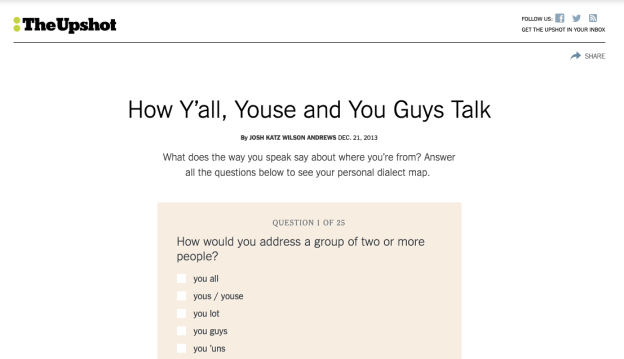
How Y’all, Youse and You Guys Talk
This New York Times interactive became one of their most-read stories of all time

There are two broad categories of exploratory story:

  1. Interactive stories characterised by an explicit ‘call to action’  like “explore”, “play” or “Take the quiz” — or a more implicit invitation to users to explore what has been “Mapped” or “Every X that ever happened”; and
  2. Exploratory features that raise (and then answer) a question. These features often combine more than one of the first three angles (scale, change, ranking) or apply the angle to more than one measure or category. The key quality is that the core angle of the feature is ‘we explore’ multiple aspects rather than ‘we reveal the scale/rank/change’ of one main thing.
Continue reading

Is there a ‘canon’ of data journalism? Comment call!

Looking across the comments in the first discussion of the EJC’s data journalism MOOC it struck me that some pieces of work in the field come up again and again. I thought I’d pull those together quickly here and ask: is this the beginnings of a ‘canon’ in data journalism? And what should such a canon include? Stick with me past the first obvious examples…

Early data vis

These examples of early data visualisation are so well-known now that one book proposal I recently saw specified that it would not talk about them. I’m talking of course about… Continue reading