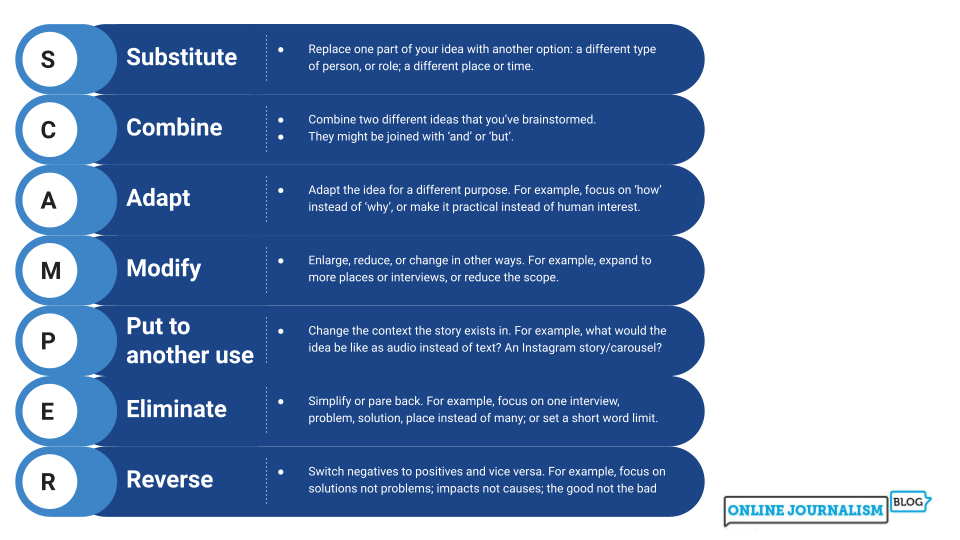
One of the techniques that can be used to come up with more creative story ideas is the SCAMPER method.
SCAMPER is a mnemonic for seven different actions that can be applied to ideas in order to improve those ideas or generate more interesting alternatives. It is a technique adapted from design and engineering circles — but with just a little thought it can be applied to journalism too.
The most basic change to the Inverted Pyramid of Data Journalism is the recognition of a stage that precedes all others — idea generation — labelled ‘Conceive’ in the diagram above.
This is often a major stumbling block to people starting out with data journalism, and I’ve written a lot about it in recent years (see below for a full list).
The second major change is to make questioning more explicit as a process that (should) take place through all stages — not just in data analysis but in the way we question our sources, our ideas, and the reliability of the data itself.
A third change is to remove the ‘socialise‘ option from the communication pyramid: in conversation with Alexandra Stark I realised that this is covered sufficiently by the ‘utilise’ stage (i.e. making something useful socially).
Alongside the updated pyramid I’ve been using for the past few years I also wanted to round up links to a number of resources that relate to each stage. Here they are…
I’m speaking at the Broadcast Journalism Teaching Council‘s summer conference this week about artificial intelligence — specifically generative AI. It’s a deceptively huge area that presents journalism educators with a lot to adapt to in their teaching, so I decided to put those in order of priority.
Each of these priorities could form the basis for part of a class, or a whole module – and you may have a different ranking. But at least you know which one to do first…
Priority 1: Understand how generative AI works
The first challenge in teaching about generative AI is that most people misunderstand what it actually is — so the first priority is to tackle those misunderstandings.
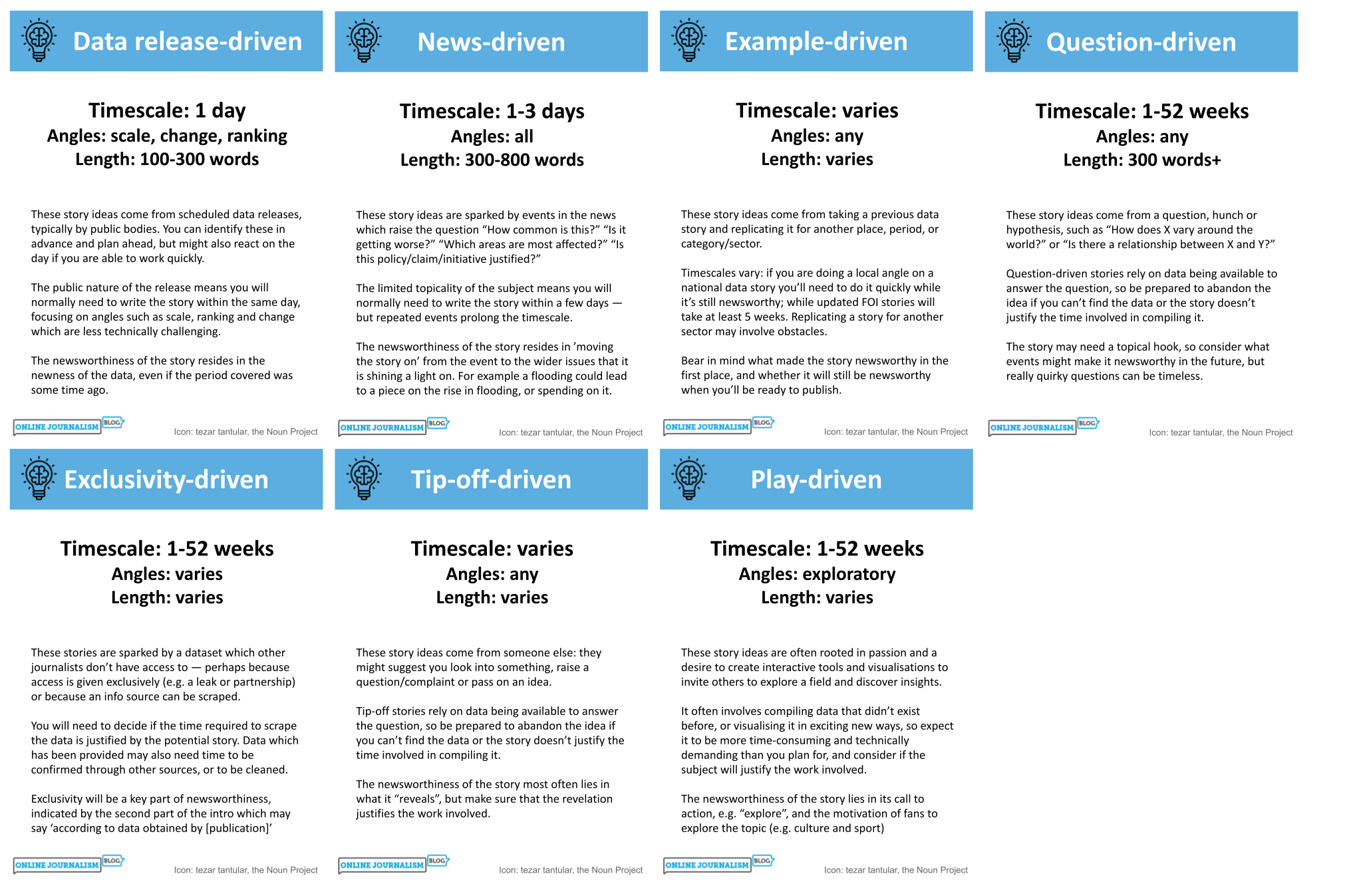
As part of the process I also created a series of cards, available as a printable PDF, which you can use to prompt these ideas in a classroom or editorial brainstorming situation. Please let me know if you find them useful!
Describing journalism as a creative profession can cause discomfort for some reporters: we portray journalism as a neutral activity — “Just the facts” — different to fiction or arts that appear to ‘create something from nothing’.
But journalism is absolutely a creative endeavour: we must choose how to tell our stories: where to point the camera (literally or metaphorically), how to frame the shot, where to cut and what to retain and discard, and how to combine the results to tell a story succinctly, accurately and fairly (not always the story we set out to tell).
We must use creativity to solveproblems that might prevent us getting the ‘camera’ in that position in the first place, to find the people with newsworthy stories to tell, to adapt when we can’t find the information we want, or it doesn’t say what we expected (in fact, factual storytelling requires an extra level of creativity given that we can only work with the truth).
All of those are creative decisions.
And before all of that, we must come up with ideas for stories too. The journalist who relies entirely on press releases is rightly sneered at: it is a sign of a lack of imagination when a reporter cannot generate their own ideas about where to look for news leads, or how to pursue those. Continue reading →
The financial crisis speeds up the newspapershift. Media diverges. Newspapers become television, television becomes a press agency. And everything becomes the web. Probably not a single news websites makes enough revenue to employ the same amount of journalists traditional media like newspapers and television employ. The result is a shift. Not in demand, in distribution. What will happen, and how will this shift change organizations?
Here are some ideas and thoughts that I think make sense. Please help me sharpen this concept, or point me at my fallacies. It would be interesting to have a discussion about this. Continue reading →




 Online Journalism Blog