Tag Archives: interactivity

Try it, refine it – or throw it away

Try new stuff! If it doesn’t work, just stop doing it. Then move on and try something else.

That’s what Mackenzie Warren, director of content at Gannett Digital (that’s the digital division of what’s currently the USA’s largest media company), advised a group of Norwegian media executives at the Norwegian Institute of Journalism this week.

Now, let me first point out that Mackenzie Warren has been a journalist since the age of 14. He’s been a photographer, reporter, online editor, managing editor… just about anything you can be in a newsroom. Except that at Gannett, and at Fort Myers News-Press, where he worked before heading up the digital content section at Gannett, they no longer call it a newsroom.

“We’ve done away with the word “newsroom”. There’s no news in a newsroom (desk reporters are often the last to hear of a story). Plus, it’s not news we do – it’s aquiring, processing and distributing information”, he said.

Now, the Gannett publications have more of a control centre where section editors (sports, news etc., not print, online or TV) monitor the competition and also what the readers and viewers are responding to at any time. Continue reading

Model for the 21st century newsroom pt.6: new journalists for new information flows

new journalists for new information

new journalists for new information

Information is changing. The news industry was born in a time of information scarcity – and any understanding of the laws of supply and demand will tell you that that made information valuable.

But the past 30 years have seen that the erosion of that scarcity. Not only have the barriers to publishing,  broadcast and distribution been lowered by desktop publishing, satellite and digital technologies, and the web – but a booming PR industry has grown up to provide these news organisations with ‘cheap’ news.

Information is changing. Increasingly, we are not seeking information out – instead, it finds us. The scarcity is not in information, but in our time to wade through it, make meaning of it, and act on it.

Information is changing, and so journalists must too. In the previous parts of this series I’ve looked at how the news process could change in a multiplatform environment; how to involve the former audience; what can now happen after a story is published; journalists and readers as distributors; and new media business models. In this part I want to look at personnel – and how we might move from a generic, hierarchy of ‘reporters’, ‘subs’ and ‘editors’ to a more horizontal structure of roles based on information types. Continue reading

US election coverage – who’s making the most of the web?

Elections bring out the best in online journalism. News organisations have plenty of time to plan, there’s a global audience up for grabs, and the material lends itself to interactive treatment (voter opinions; candidates’ stances on various issues; statistics and databases; constant updates; personalisation).

Not only that, but the electorate is using the internet for election news more than any other medium apart from television (and here are some reasons why).

PaidContent has a good roundup of various UK editors’ views, and decides blogs, Twitter and data are the themes (more specifically, liveblogging and mapping). Continue reading

Elections08: Storytelling with public databases

Written by Wilbert Baan

Today is the day of the US elections. I don’t think we ever had a live event on the web that will get so much live coverage. This means incredible amounts of information will be published over all kind of services and social networks. Websites like Facebook, Twitter, Flickr, WordPress, Blogger and many more.

Most popular web services have programmable interfaces. These interfaces allow developers to extract information out of the system. This creates a whole new genre of storytelling: storytelling with public databases. You can aggregate the information you need and sort it the way you want.

To prove the concept I made three small mock-ups. They all use search.twitter.com to see how people voted.

When I made the first the first animation Erik Borra replied by developing the idea into something that stores the data retrieved from Twitter in a database. I made a new interface that shows a graph based on what people say they voted on Twitter. And the result is a Twitter Poll.

These three examples are not representative data, it is extracted from Twitter. But it shows you how much personal and valuable information is in the public database. All you have to do is ask yourself what you want to tell to your readers and if this information is available.

I voted

This animation gets the latest twitter message where someone says they voted on McCain or Obama. It automatically refreshes. Continue reading

Blogging journalists pt 6: Blogging and the audience relationship: “The best stories are a result of incredible conversations”

The 6th part of the results of my survey of blogging journalists looks at how blogging has affected the relationship with the former audience.

Of all areas covered by the survey the relationship with the audience was by far the most affected, with over half of respondents saying it had been “enormously” or “completely” changed. In particular, journalists felt they had developed a more personal relationship with the reader, who was no longer an anonymous figure. Continue reading

It’s time to relieve the stress of RSS. Newspapers, make your own readers!

(This entry was originally posted by Dave Lee on jBlog)

A few days ago on this blog, Paul Bradshaw wrote what he called one of the most important posts he’s ever made. Here it is.

In it he describes how the era of the awkward, socially backward geek is nearly behind us. They’re not geeks, he says, they’re early adopters. And you’d better listen to them if you want to stay a step ahead of the game. Continue reading

Maps, mashups and multimedia: online journalism students tackle interactivity

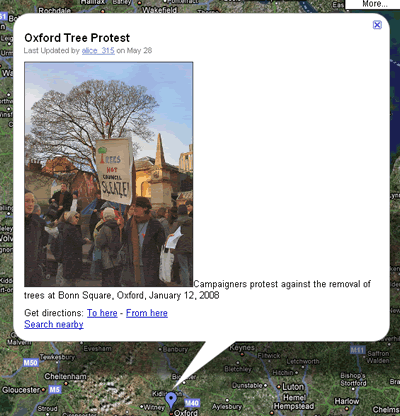
Alice Fanning's map of UK eco stories

Alice Fanning's map of UK eco stories

As a new semester begins it seems a good time to finally post about how my second year journalism degree students approached the ‘interactive’ element of their portfolio way back in May (yes, everything they do is interactive, but bear with me).

For the first time I gave them an open brief in terms of what they did interactively (in previous years I asked them to produce Flash interactives). Having been taught how to create everything from audio slideshows and image maps to multimedia interactives, Google Maps and Yahoo! Pipes mashups, I was curious to see what they would pick. Would they all plump for the same option? Continue reading

Quebec news websites added to Interactivity Index

David Carter in Canada has added several news websites from Quebec to the Interactivity Index, which now compares the interactive features of news websites in the UK, US, France, Macedonia, Portugal, Spain, Netherlands, Norway, Belgium, Czech Republic, Hungary, Poland and Switzerland. Scores for the Canadian websites range from Voir’s 1300 points down to Quebec Science with 300. Anyone want to add Canadian websites outside of Quebec?

Try it out below:

Lancashire Telegraph and Lancashire Evening Post – more interactive than The Independent?

Blogging recently on Newsquest’s relaunch of its websites, I feel I was a bit harsh on the Lancashire TelegraphContinue reading

How Portuguese News Websites (don’t) use Citizen Journalism

Alex Gamela looks at citizen journalism – or the lack of it – in the Portuguese media landscape

We’ve been watching a significant change in the Portuguese news media during the last few years. From national to local newspapers, radios and TV channels, everyone is building their presence online, with more or less aptitude or quality. Still, the effort is noticeable.

Video thumbnail. Click to play Portugal Diário is a exclusively online outlet that has recently gone through a deep redesign.

But this investment in new platforms of communication doesn’t mean the companies are following the latest trends, or leaving their somewhat conservative approach to the full possibilities of the web. The news websites in Portugal are mostly a repository for print content, since many don’t have exclusively online journalists, and the resources for online content are rather limited, especially as multimedia content is concerned, though slowly the tide is turning, mainly due to the efforts of major newspapers, that are trying to improve and take the step forward in online content.

This scenario, of slow and uneven development of new media content, is useful to explain why the interactivity between media and users is practically nonexistent. Many still don’t grasp the concept of participative/citizen journalism and community, but companies and newsroom managements aren’t the only ones to blame, since there are other factors to consider: Continue reading