Here’s the good news for mobile phone websites: Vodafone has “seen a 50% rise in revenues from its data services over the past quarter, after the number of its customers using the web from mobile devices more than doubled.” Continue reading →
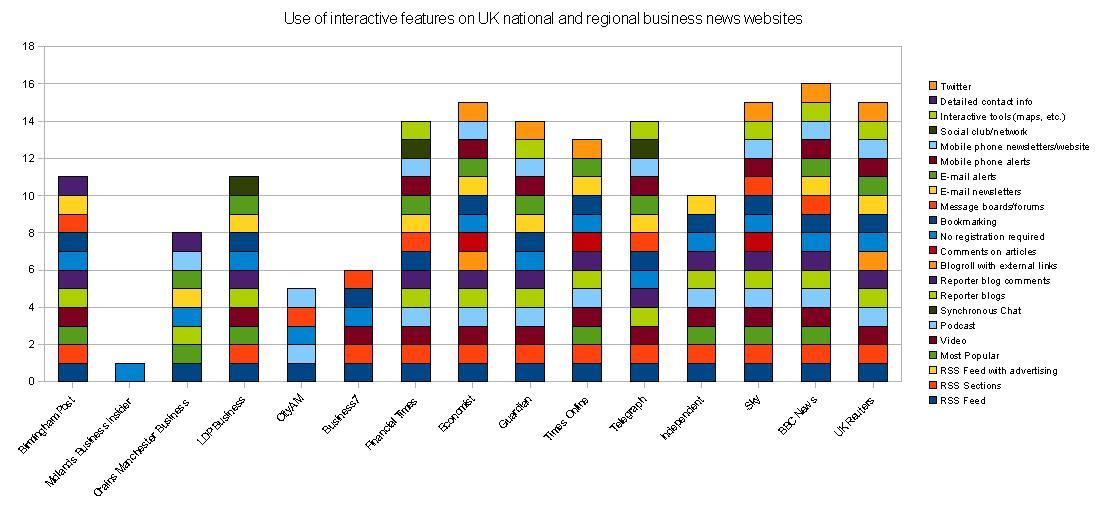
That’s the question Birmingham Post reporter Joanna Geary has been asking herself, and has come up with the following rather lovely graphic:
Clickon the image for a larger, more readable version – you’ll see she’s looking for availability of email contacts, use of things like maps, blogs, bookmarking, video (is that interactive? Or multimedia?), email newsletters, mobile alerts, RSS, podcasts, chats, forums – and Twitter: “I know it’s not yet a mass communication device but I think it’s a good indicator of those who are thinking about the development of the market” Continue reading →
What happens when you bring together local journalists, bloggers, web publishers, online journalism experts and new media startups – and get them talking?
That was the question that JEEcamp sought to answer: an ‘unconference’ around journalism enterprise and entrepreneurship that looked to tackle some of the big questions facing news in 2008: how do you make money from news when information is free? Where is the funding for news startups? How do you generate community? What models work for news online? Continue reading →
The past decade has seen more change in the craft of journalism than perhaps any other. Some of the changes have erupted into the mainstream; others have nibbled at the edges. Paul Bradshaw counts the ways…
From a lecture to a conversation
Perhaps the biggest and most widely publicised change in journalism has been the increasing involvement of – and expectation of involvement by – the readers/audience. Yes, readers had always written letters, and occasionally phoned in tips, but the last ten years have seen the relationship between publisher and reader turn into something else entirely.
You could say it started with the accessibility of email, coupled with the less passive nature of the internet in general, as readers, listeners and watchers became “users”. But the change really gained momentum with… Continue reading →
On the good side, at least it means the Reading Evening Post check on their YouTube videos (or perhaps the web person told them they were getting an unusual number of hits coming from YouTube).
But on the bad side, was it worth it? On the one hand, it’s clearly an attempt to stop people clicking through to the (at last count) three sites criticising the production and editorial values of the piece.
But did they think beyond that knee-jerk reaction?
Firstly, it means you’re not allowing people to look at the debate generated by video. And hold on – that means you’re also stopping people clicking through to your own site.
Wasn’t that the point of putting it on YouTube?
Secondly, someone – in this case Adam – is likely to spot the ruse and… oh yes, just when everyone was starting to forget about it, here we are still talking about that awful video.
And now we’re talking about some flawed decisions regarding online distribution too.
I won’t even touch on the censorship issues this raises, and the fuel this adds to the suspicion by readers that journalists can’t take criticism.
Anyway, let’s end on a more positive note: this video from the same YouTube channel may be a bit rough and ready but at least it’s got some ideas and leaves the office:
Yes, the previous contender for Worst Newspaper Video have done it again. But this time, instead of Sports Editor David Wright, it’s young gun News Reporter Stuart White, who looks quite smart in the official picture that sits above a slightly less well-dressed moving picture version of the same.
The 1980s-era production style remains, with the same stock music, garish graphics – and this time, some appalling spinning, zooming, transition wipes.
Stuart’s challenge: to read out the day’s headlines “in just 60 seconds“. Yes, that’s some challenge. Perhaps someone should suggest that idea to BBC3.
One problem: when you take out the credits it’s not actually 60 seconds, which may be why Stuart is drowned out by the closing music at the end, just as David Wright was before him. Do they ever watch their own videos?
I’ll be more barbed: Stuart has the flat delivery of a 12-year-old reading ‘What I did on my summer holidays’, while his eyes flit below the camera like he’s checking his emails as well as reading the headlines. Presumably he’s reading a script. Doesn’t he know what the news is?
And what was that about a “sweet Haribo ring”? Some lessons in writing for broadcast needed.
Of course I’m being harsh, and as before this is not Stuart’s fault. Step up owners Surrey and Berkshire Newspapers Limited, part of the Guardian Media Group.
The one good thing is they’ve discovered YouTube, so unlike last time, I can embed it below for your convenience and their viewing figures. Let’s see if I can generate more views from this blog than from their own site – at least it will prove the value of making your video embeddable.
Last week I interviewed Mike Hill, Deputy Editor of the Lancashire Evening Post, for an article on changing tools and approaches in local newsrooms (due to appear on Journalism.co.uk). Mike has some interesting plans on using surveys beyond the simple reader poll (since reported here), and experiences of the weaknesses of geotagging, among other things. The interview can be heard here – it’s around 10 minutes.
For many years the Association for Journalism Education (AJE) has debated whether its institutions should boycott the NCTJ. And for many years the NCTJ has all but ignored it. At this year’s AJE AGM the issue cropped up once again.
The complaints are copious, and I won’t list them all here, but revolve around some core issues: Continue reading →



 Online Journalism Blog