Category Archives: online journalism

Why investigative journalism needs to get networked

I’ve written a piece in the latest Press Gazette about the need to “take down the walls, stop mystifying investigative journalism and include readers in the process, starting now.” Sadly, they’ve pigeonholed it as being about “blog investigations”. Never mind: you can read it here.

How successful bloggers become bureaucratized too

Making Online NewsI’ve recently been reading ‘Making Online News‘ a book of ethnographic studies of online news production. Tucked towards the back of the book is a chapter called The Routines of Blogging by Wilson Lowrey and John Latta. It is one of the few studies I’ve read to look not at journalists, but at the work practices of bloggers – specifically, political bloggers.

And their findings support what I’ve increasingly suspected: “the more relevant bloggers become in terms of audience and influence, the more their production routines resemble those of professional journalists.” Continue reading

RSS readers: why have just one?

Recently my long love affair with Bloglines has been hitting the rocks. I’ve been seeing another RSS reader. Yes, it’s Google Reader.

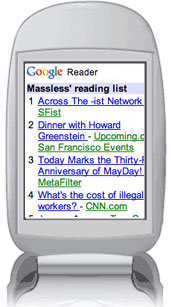
It started on the bus to work. You see, the mobile version of Bloglines doesn’t do it for me. My ‘morning paper’, now, is to scroll through the headlines from the dozens of blogs I subscribe to – in Google Reader mobile. If it’s something I might want to return to later, I ‘star’ it. If the blog post supports it, I might even bookmark it on del.icio.us. Continue reading

Investigative journalism book – and my chapter on blogs

Investigative journalism bookHow remiss of me not to mention that the second edition of Investigative Journalism is now out, including a chapter on ‘Investigative Journalism and Blogs’ by yours truly. As it happens, if you buy it from the OJB Amazon affiliate shop (or anything else for that matter) the commission will go towards an ‘open source’ investigative journalism venture I’m putting together.

“Journalists are cheap” – SEO and why newspapers should cut out the middlemen

Last weekend I attended the first WordCamp UK – a conference for WordPress-using bloggers, developers and designers. Aside from the tips on plugins, backups and content management systems, one line stood out for me “If you’re a web developer get to know a journalist. We need them. And they’re cheap.” Continue reading

Should journalism degrees still prepare students for a news industry that doesn’t want them?

UPDATE (Aug 7 ’08): The Annual Survey of Journalism & Mass Communication Graduates suggests employment opportunities and salaries are not affected.

J-schools are generally set up to prepare students for the mainstream news industry: print and broadcasting, with a growing focus on those industries’ online arms. There’s just one small problem. That industry isn’t exactly splashing out on job ads at the moment…

The LA Times is cutting 150 editorial jobs and reducing pages by 15%; The Atlanta Journal-Constitution cutting nearly 200 jobs; the Wall Street Journal cutting 50 jobs; Thomson Reuters axing 140 jobs; in the UK Newsquest is outsourcing prepress work to India, while also cutting jobs in York and Brighton; Reed Business Information, Trinity Mirror and IPC are all putting a freeze on recruitment, with Trinity Mirror also cancelling its graduate training scheme and cutting subbing jobs. In the past two months almost 4,000 jobs have vanished at US newspapers (Mark Potts has this breakdown of June’s 1000 US redundancies). In the past ten years the number of journalists in the US is said to have gone down by 25%.

Given these depressing stats I’ve been conducting a form of open ‘panel discussion’ format via Seesmic with a number of journalists and academics, asking whether journalism schools ought to revisit their assumptions about graduate destinations – and therefore what they teach. The main thread is below.

The responses are worth browsing through. Here’s my attempt at a digest: Continue reading

Using social media for newsgathering: a one-day course by yours truly

If you want to pick my brains on using various online tools to track breaking news and pursue stories, I’m going to be teaching a one day course on the topic next month. You can find more details and booking here.

This may be something I do more of, so if there are any areas you’d like to see me do a training course/open session on, let me know in the comments below.

Crowdsourcing, the Guardian, and international aid programs (guest post by Rick Davies)

I recently invited Rick Davies, external monitor for the Guardian’s Katine project, to provide his insight into how much crowdsourcing has actually taken place – and what issues have arisen around that. This is his response:

In October 2007 Paul wrote an enthusiastic post about the Guardian’s involvement in what could be seen as a crowdsourcing experiment with AMREF, an African NGO working in Katine sub-country in Uganda, and supported by the Guardian.  In that post Paul quoted Guardian editor Alan Rusbridger:

“We’ll need money obviously. But, just as importantly we need advice and involvement. Among our readers are water engineers, doctors, solar energy experts, businessmen and women, teachers, nurses, farmers. We absolutely don’t need a stampede of volunteers, but we would like a technical know-how bank of people who are prepared to offer time and advice. We’ll let you know how to get involved as we go.” Continue reading

New York Times + LinkedIn = another step towards personalised news

The New York Times and LinkedIn have entered into a partnership that will see LinkedIn users “shown personalized news targeting their industry verticals … and will then be prompted to share those stories will professional associates.” Meanwhile, NYT readers will see a widget directing them to LinkedIn (see image below). Continue reading