Category Archives: online journalism

An investigation into football agents – and funding for Flemish-African projects

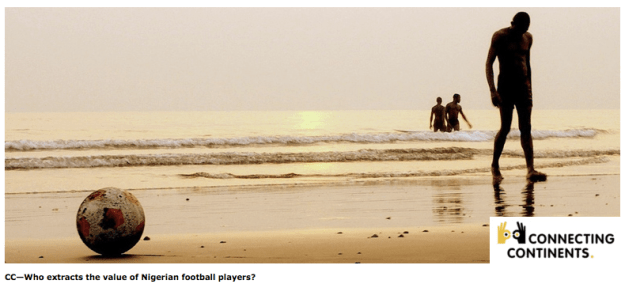
Footballer

For the last few months I have been working on an investigation into football agents with the rather wonderful Nigerian journalists Yemisi Akinbobola and Ogechi Ekeanyawu. You can now read the resulting story on both IQ4News and Nigeria’s Premium Times. Continue reading

Google Digital News Roadshow in Birmingham December 14

Google’s Digital News Roadshow comes to Birmingham on Monday December 14. It’s open to journalists, hyperlocal bloggers and journalism students, as well as pretty much “anyone with a strong interest in journalism.”

Here’s the blurb:

“Google News Lab and Trinity Mirror Group invite you to attend this free workshop session where short, bite size presentations;  will give you a clear overview of some of the tools, tips and tech that journalists are using around the world to complement their stories. Speakers will provide examples and case studies that could help inspire and engage your audiences.

It’s free, and drinks and “light refreshments” are included. Register here.

How linking brought the Mirror’s Hilary Benn speech transcript to life – while driving traffic & SEO

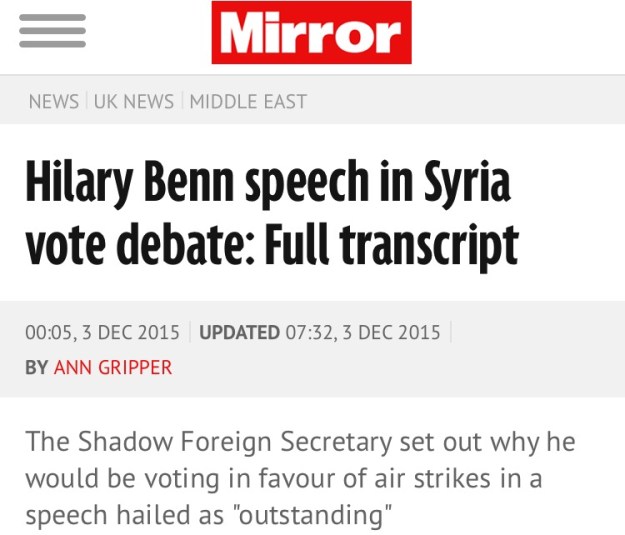
Mirror Hilary Benn Headline

It’s not unusual for news organisations to publish full transcripts of political speeches – but The Mirror have done something simple with Hilary Benn’s speech on a vote on air strikes in Syria which seems like such a no-brainer you wonder why everyone doesn’t do it.

It is simply this: they have added links.

In doing so they transform a linear, text-only experience which assumes certain knowledge on the part of the reader (actually, listener) into something journalistic: reporting that adds context and illustration.
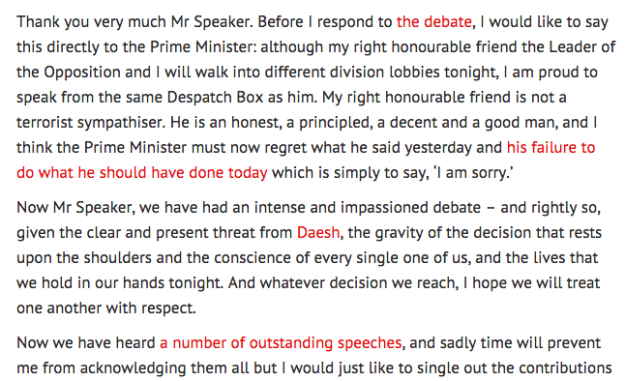
hilary benn speech links

The links added to the Hilary Benn speech help provide context and drive traffic

Here are some of the roles that those links perform:

  • Directing the user to broader coverage of the debate as a whole.
  • Providing background on criticism of the Prime Minister for not apologising.
  • Explaining what Daesh is (Benn assumes the listener knows who they are; The Mirror, publishing his words for a different audience, does not).
  • When Benn refers to outstanding speeches, we can click to read a listicle distilling the best of those.
  • Linking to reports on the Paris attacks.

This last point bears some elaboration: too often journalists assume that their online readers are as familiar with the publication as print readers used to be.

But online readers are more diverse and read much more widely than a typical print readership: there is no guarantee that a typical user landing on a page on your site has ever read anything else on it; and it’s even less likely that they read everything.

This particular article is a good example: from an SEO perspective it is targeted at people Googling for ‘Hilary Benn speech‘ or ‘Hilary Benn speech transcript’.

Can we assume they read The Mirror’s coverage of the Paris attacks? No. It is much more likely that they heard about the Paris attacks through social media and broadcast bulletins.

Online, it’s more likely they checked the BBC site than the Mirror.

There’s also a point to make about international audiences: what may have dominated the news in Europe for days may have been missed by readers elsewhere in the world. Never assume your audience knows what you do.

The SEO role

The ‘Carnage in Paris’ link isn’t just about driving internal traffic: it is also about SEO. Internal linking helps Google to find and understand content better.

For the same reason the word ‘Daesh‘ is linked not once but every time it is mentioned: the Mirror is trying to strengthen the link (in Google’s terms, the relevance) between that word and their post explaining what Daesh is and why the term is being used instead of ISIS or Isil.

Unfortunately, this also means that other opportunities to serve the reader through links can be missed.

The speech, for example, mentions a United Nations resolution, but there is no link to that. It mentions debate about the ‘70,000 troops’ figure, but does not link to any factchecking on that figure. Both of these might involve linking outside the site, and sadly this isn’t a priority.

This is something that needs to change in news organisations. In some cases, external linking is discouraged in the mistaken belief that it will ‘drive traffic elsewhere’. In fact, there is evidence that  it leads people to return to your site (it’s even been linked to evidence of digital progress). This is like a TV producer arguing that they should not film on location in case people decide to go there instead of watching TV.

There is even evidence that suggests it makes a small impact on your SEO; and no evidence that it is a negative factor.

The fundamental role of linking

Links are as fundamental to online journalism as pictures are to TV, and yet we are not there yet: still you will find articles published online with no links at all.

The Mirror’s approach is a great example of this. To see why, you only have to imagine if television had no footage of Benn speaking (as would have been the case 30 years ago). In that situation TV would not simply run audio on a black screen: they would add pictures to illustrate what we were hearing. Likewise, if radio only had a transcript they would find aural ways of bringing that to life and adding context.

Links, of course, can do both. And embedding – essentially a form of linking – can do. In fact, that’s the approach the Express adopt on their transcript, alongside images and a gallery. And it’s also useful to note that the Mirror still embed the video of the speech at the top of their piece, even though they have devoted a separate post to the video alone.

Because: why not?

Respond by Monday: inquiry into cyber security and protection of personal data

data-breaches-datavis

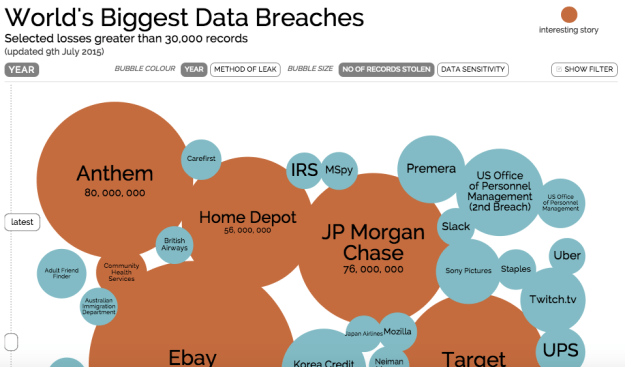
The World’s Biggest Data Breaches visualised by David McCandless. Click to see interactive and updated version

At the same time as one arm of the UK Government is proposing to force internet and telecomms service providers to store data on the internet and phone activity of every citizen, another part is holding an inquiry into lax security by one ISP which led to details being hacked.

It’s a rare opportunity to have your say on the clear personal security issues that the Investigatory Powers Bill raises – but the deadline is Monday.

Have your say here.


A simple hyperlocal experiment which shows how publishers can engage with different audiences

liveblog engagement

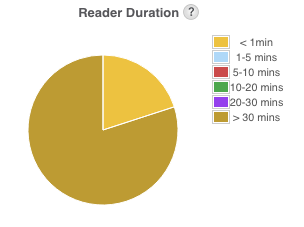
Civic engagement? Most readers spent more than 30 minutes on the liveblog

On Monday I was involved in a fascinating experiment in civic engagement: 10 hyperlocal blogs all agreed to embed a liveblog of a hustings which would give inhabitants of the largest local authority in Europe an insight into the next council leader.

The liveblog itself was to be maintained by student contributors to the Birmingham Eastside news site. The decision to offer it out to hyperlocal sites across the city seemed obvious – so why aren’t publishers doing this regularly? Continue reading

“It’s black and white to colour”: Ben Fry on data visualisation’s past and future

Ben-Fry-visualization

Ben Fry published his book Visualizing Data in 2007, before the term ‘data journalism’ had entered the professional vocabulary. Since then, Fry has been developing Processing, an open source “language for learning how to code within the context of the visual arts”, and he is a principal at Fathom, a Boston design and software consultancy which has created visualisation projects for National Geographic; Bill, Hillary & Chelsea Clinton Foundation and Bill & Melinda Gates Foundation

Catalina George asked him a few questions about his current work and his advice to aspiring data journalists.

Visualisation, a reinvented tool

World-eats-visualization-Fathom

For a better view of the world calories consumption, the user can see how much this differs from China to the UK @Fathom

One of your Fathom projects was a data visualisation for National Geographic’s What the World Eats”. The graphic part can play a great role to enrich our perception and understanding of reality. But what does the development of visualisation mean for journalism?

I think what’s called “visualisation” has been around a long time for journalism. Otto Neurath was doing this in the 1920s. I think it’s been receiving more attention in recent years because we have the means to more easily distribute interactive works, which is a boon for more sophisticated takes on data. Continue reading

Come help dig into data on football agents – and eat pizza

Pizza

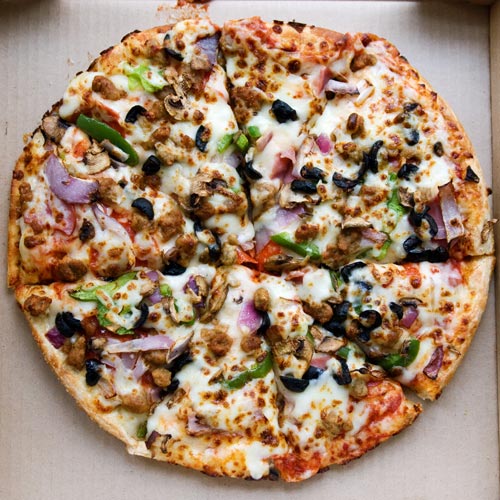
Pizzas and footballs are both round. That’s enough justification for us. Image: Adam Kuban

Next Friday (November 13) I’ll be holding a day full of activities in Birmingham for anyone interested in digging into the world of football agents.

You won’t need any special skills – you can take part by doing basic internet searches, or you can bring your data journalism mojo and play with the data we’ve already gathered.

And we’ll also have people on hand to show you a range of useful techniques if you’re interested.

The special hackday is part of an investigation I’m doing, and we’re also working with OpenCorporates as part of their #FlashHacks series to build open data on football agents, identifying the biggest operators and their ownership structures.

If you can’t make it for the whole day feel free to drop in for part of it. Oh, and there’ll be pizza, stickers and t-shirts.

You can sign up and find more details about location and timings here.

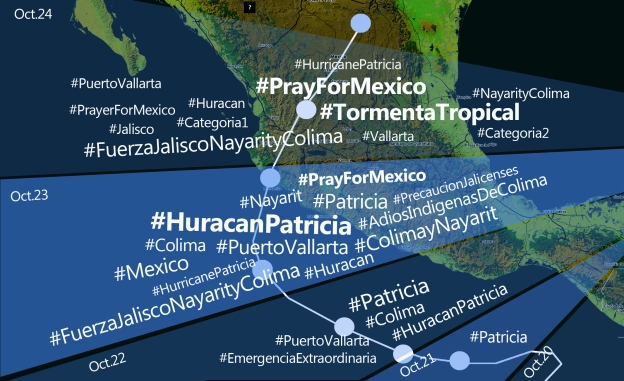
The passing of Hurricane Patricia through Mexico – as told by hashtags

#Patricia started shyly trending in Mexico on Wednesday, October 21st, when it was simply one more tropical storm in the 2015 Pacific hurricane season.

By the end of the day it was 49th on the list of Twitter trending topics among Mexican users – who like many people around the world were busy celebrating #BackToTheFutureDay.

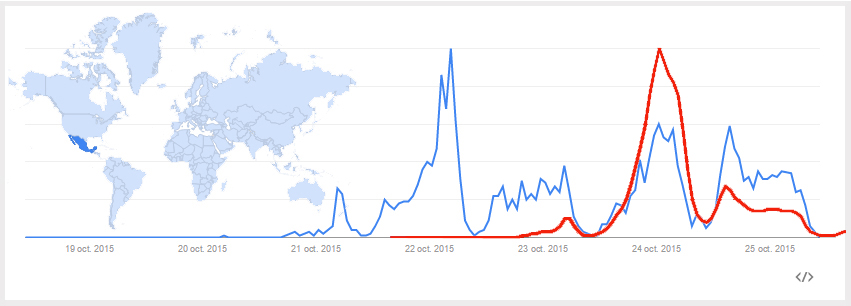
In the days that followed, however, the storm evolved into a terrifying category 5 hurricane that hit Mexico late on Friday, October 23, generating all kinds of interest, as the following graph from Google Trends shows:

hurricane patricia google trends - Spanish

Google search for terms linked to Patricia in Spanish: tropical storm (blue) and hurricane (red). Info: Google Trends.

These are some of the highlights of what happened on social media during the hurricane days: Continue reading

17 takeaways on mobile publishing from Monetising Media 2015

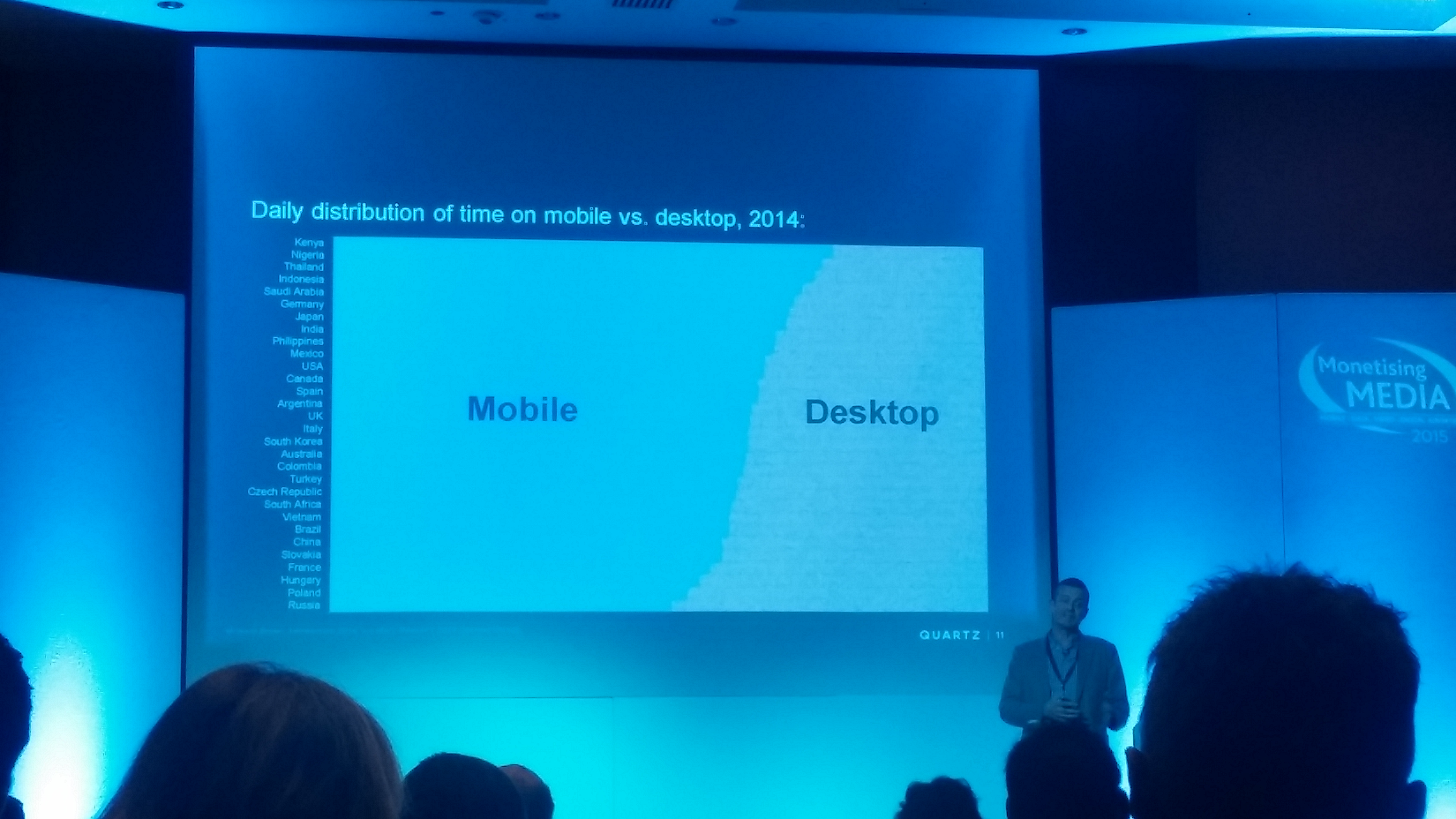
mobile desktop timeHow do you reach an audience which is consuming more content on mobile than desktop – and at different schedules to the traditional print model? At Monetising Media last week industry leaders shared their concerns and strategies for succeeding on mobile without losing quality and content. Maria Crosas Batista sums up some of the key takeaways:

Product rather than platform: Lee Wilkinson, Hearst Magazines International

Lee Wilkinson bets on product rather than platform:

“If your audience is the core of a product strategy you are more likely to engage and reach them when your content is out there.”

Continue reading