Author Archives: Paul Bradshaw

Longform writing: how to write a beginning to hook the reader

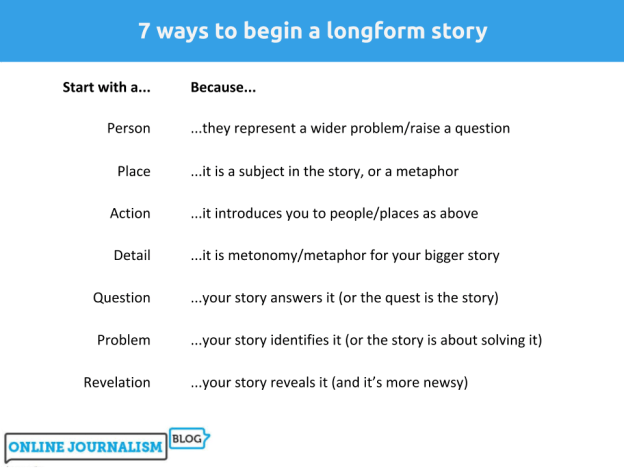
7 ways to begin a longform story: person, place, action, detail, question, problem, revelation

Previously I’ve looked at 7 story types that can help organise an investigation and the 5 stages of a longform story. In this follow-up post (taken from a class in my MA in Data Journalism and MA in Multiplatform and Mobile Journalism) I look in more detail at the editing process once you have a longform story laid out — specifically, how to start that long feature.

Beginnings are notoriously tricky for any writer. For news reporters the advice is simple: start with the ‘new’ thing in your story, and make sure there is a verb in there: a person has said something; a report has revealed something; authorities are looking for someone, warning about something, planning to do something; and so on.

But in longform and feature writing the approach is more subtle. Although we can choose to report that something has been ‘revealed’ right at the start, this risks removing tension from the story and leading the reader to abandon it before they have the full picture.

Instead, then, journalists use a number of techniques to keep the reader engaged across a longer format — with the important implied promise that the story is going to be worth it.

So, for anyone struggling to think of a way to start a longer story — or feel that you can improve the approach you’ve chosen — I’ve pulled together seven types of beginning that are used in longform reporting and feature writing, with some considerations to bear in mind — and plenty of examples. Continue reading

Meme journalism on Instagram in Denmark: “It’s necessary if we want to play a part in the lives of the younger audience”

When I saw Danish broadcaster TV2 Østjylland’s innovative meme-driven Instagram strategy to reach younger audiences, I immediately wanted to know more. So I spoke to Head of News Louise Petterson and Art Director Kristine Helms to find out how the organisation took on the challenge of a new language on a new platform — and what they have learned along the way.

With TV audiences ageing and public service broadcasters struggling to retain mass appeal, many news organisations have looked to new platforms to reach younger audiences. At TV2 Østjylland, Instagram was part of the mix — but they were acutely conscious that the organisation could no longer rely on traditional approaches to storytelling that journalists were used to.

“We couldn’t take a TV narrative and just put that onto Instagram or Facebook,” explains Louise Petterson. “We had to define a new narrative, a new way of communicating with a younger audience. Continue reading

When you get data in sentences: how to use a spreadsheet to extract numbers from phrases

Unduly lenient sentences review scheme inadequate

This BBC story involved converting phrases into numbers that could be used in calculations

Earlier this month the BBC Data Unit published a story on unduly lenient sentences which involved working with data that was trapped in phrases.

We needed to be able to take a collection of words such as “11 years and 5 months’ imprisonment” and convert that into something that could be used in spreadsheet calculations (specifically, comparing the lengths of time represented by two different phrases).

It’s a problem you come across every so often as a journalist — especially with FOI requests — so in this post — taken from the book Finding Stories in Spreadsheets — I’ll explain how to do that. Continue reading

The 5 stages of a longform story – and how they can help you identify sources

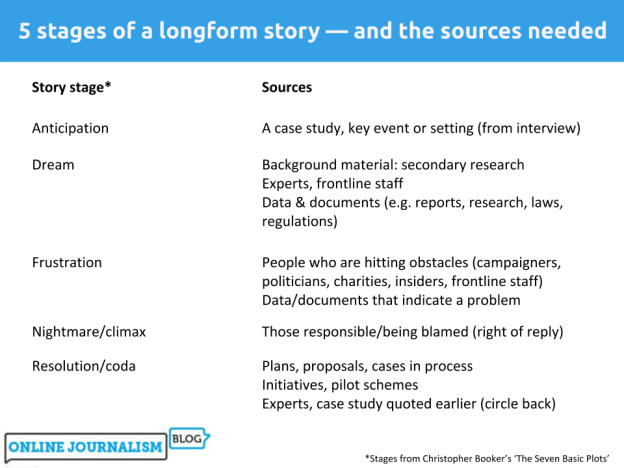
5 stages of a longform story

This year I’ve been working with my MA Data Journalism and MA Multiplatform and Mobile Journalism students on techniques for telling longer form stories. In this post I explain how a consideration of story structure can help you clarify the sources that you will need to talk to in order to gather the elements needed for an effective longform story.

In a previous post I discussed how different plot frameworks identified by Christopher Booker in his book ‘The Seven Basic Plots‘ – such as the ‘quest’ or ‘tragedy’ – can help a journalist think about longer investigations. In addition to those types of story, however, Booker also identifies 5 stages of a story. These are:

  1. Anticipation: setting, character and – crucially – ‘problem’ are introduced.
  2. Dream: we begin exploring/solving the problem.
  3. Frustration: we hit more problems.
  4. Nightmare: this is the ‘final battle’ of fiction narratives.
  5. Miraculous Escape/Redemption/Achievement of the Prize or (in the case of Tragedy) the Hero’s Destruction.

How the 5 stages work in journalism

I would argue that you can see these stages at work in most longform journalism, too. Here’s how: Continue reading

Here are 7 story types that can be used to help organise investigations

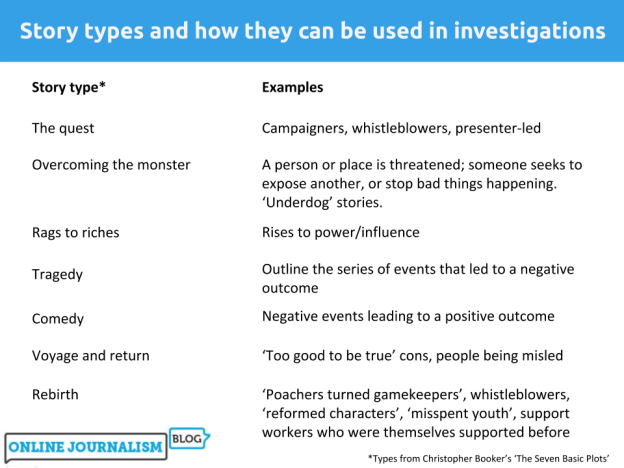
7 story types and investigations

This year I’ve been working with my MA Data Journalism and MA Multiplatform and Mobile Journalism students on techniques for telling longer form stories. In this post I explain how a consideration of seven common plot types can help you clarify what story it is you’re telling – and what you might need to tell that.

There are many ways to tell a story, and many stories to tell. An investigation can be trying to establish the cause of a problem, or solutions to that problem; it can be revealing previously hidden unethical behaviour, or shining a light on issues which are ‘hidden in plain sight’; it can be holding a mirror up to a part of society to reveal its scale; or giving a voice to that part of society as a step towards a more sophisticated understanding of problems affecting it. And depending on the type of story, you might adopt different approaches to telling it. Continue reading

FAQ: What are the essential computational skills that a journalist should develop?

Blue skyscrapers

Recognising patterns is a key skill in computational journalism (image by Stanley Zimny)

This latest group of frequently asked questions comes from an interview with Source, published here in full just in case it’s — you know — useful or something…

1. What are the essential computational skills that a journalist should develop?

Firstly, an ability to recognise patterns, or structured information. Spreadsheets are explicitly ‘data’ but some of the most interesting applications of computational journalism are where someone has seen data where others don’t.

Continue reading

GEN 2019 round-up: 4 videos to watch on the potential of data and AI

Krishna Bharat

This year’s Global Editor’s Network (GEN) Summit, in Athens, Greece, had a big focus on the use of verification and automation. BBC News data scientist and PGCert Data Journalism student Alison Benjamin went along to see what was being said about artificial intelligence (AI), data and technology in the news industry. Here are her highlights…
Continue reading

Here are 2 videos and slides from my MA/PGCert Data Journalism taster day

Earlier this month I held a special open taster class at Birmingham City University for anyone interested in my full time MA and part time PGCert courses in Data Journalism. As some people couldn’t get to the UK to attend the event I put together two video screencasts recapping some of the material covered in the session.

I’ve embedded the two videos — and slides from the day — below.

And if you want to try out some of the hands-on activities from the class, you can find them here.

FAQ: How has social media changed journalism – and what does the future hold?

tools on a shed wall

Tools image by Lachlan Donald

This latest set of frequently asked questions comes from a MA student at Coventry University who is researching Instagram. Their questions revolve around the impact of social media on journalism and Instagram in particular.

How are the new social media apps changing the way journalism is produced, distributed and consumed?

There’s a lot of scope in that question so in breaking it down it’s firstly worth making a distinction between apps (i.e. tools, used by producers to capture, publish and share) and platforms (i.e. a place where content is hosted).

So for example Instagram is a platform that hosts content which can be accessed on a tablet, or on mobile, or a desktop or laptop computer, but can also be published to through an app on mobile or tablet. Continue reading

If we are using AI in journalism we need better guidelines on reporting uncertainty

Chart: women speak 27% of the time in Game of Thrones

The BBC’s chart mentions a margin of error

There’s a story out this week on the BBC website about dialogue and gender in Game of Thrones. It uses data generated by artificial intelligence (AI) — specifically, machine learning —  and it’s a good example of some of the challenges that journalists are increasingly going to face as they come to deal with more and more algorithmically-generated data.

Information and decisions generated by AI are qualitatively different from the sort of data you might find in an official report, but journalists may fall back on treating data as inherently factual.

Here, then, are some of the ways the article dealt with that — and what else we can do as journalists to adapt.

Margins of error: journalism doesn’t like vagueness

The story draws on data from an external organisation, Ceretai, which “uses machine learning to analyse diversity in popular culture.” The organisation claims to have created an algorithm which “has learned to identify the difference between male and female voices in video and provides the speaking time lengths in seconds and percentages per gender.”

Crucially, the piece notes that:

“Like most automatic systems, it doesn’t make the right decision every time. The accuracy of this algorithm is about 85%, so figures could be slightly higher or lower than reported.”

And this is the first problem. Continue reading