The machine that learns how to stop whistleblowers

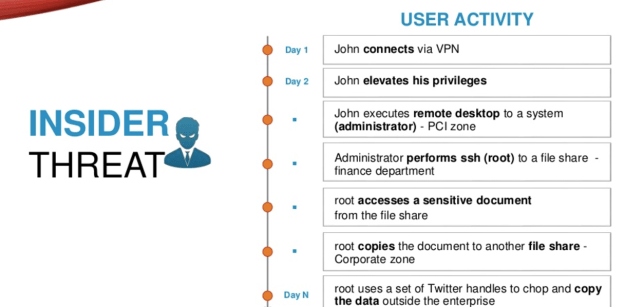
INSIDER THREAT John connects via VPN Administrator performs ssh (root) to a file share - finance department John executes remote desktop to a system (administrator) - PCI zone John elevates his privileges root copies the document to another file share - Corporate zone root accesses a sensitive document from the file share root uses a set of Twitter handles to chop and copy the data outside the enterprise USER ACTIVITY

An example of whistleblower behaviour taken from Harry McLaren’s slides

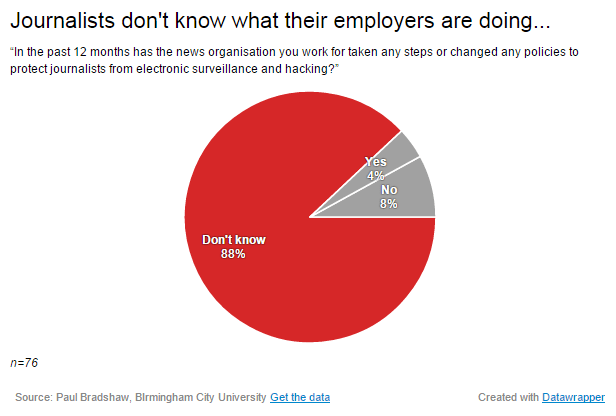
Workplace surveillance is nothing new, but this slide from Harry McLaren’s talk on Machine Learning for Threat Detection illustrates particularly well the challenges facing journalists wishing to protect whistleblowers.

McLaren is talking about malicious threats, and the way that machine learning can be used to identify suspicious patterns of behaviour. But the example given above is equally useful in illustrating the way that similar behaviour might be used to identify an employee intending to whistleblow on illegal, unethical or dangerous behaviour by his or her organisation. Continue reading

Report: looking back at 2016 — looking forward to 2017…

2017 prediction charts

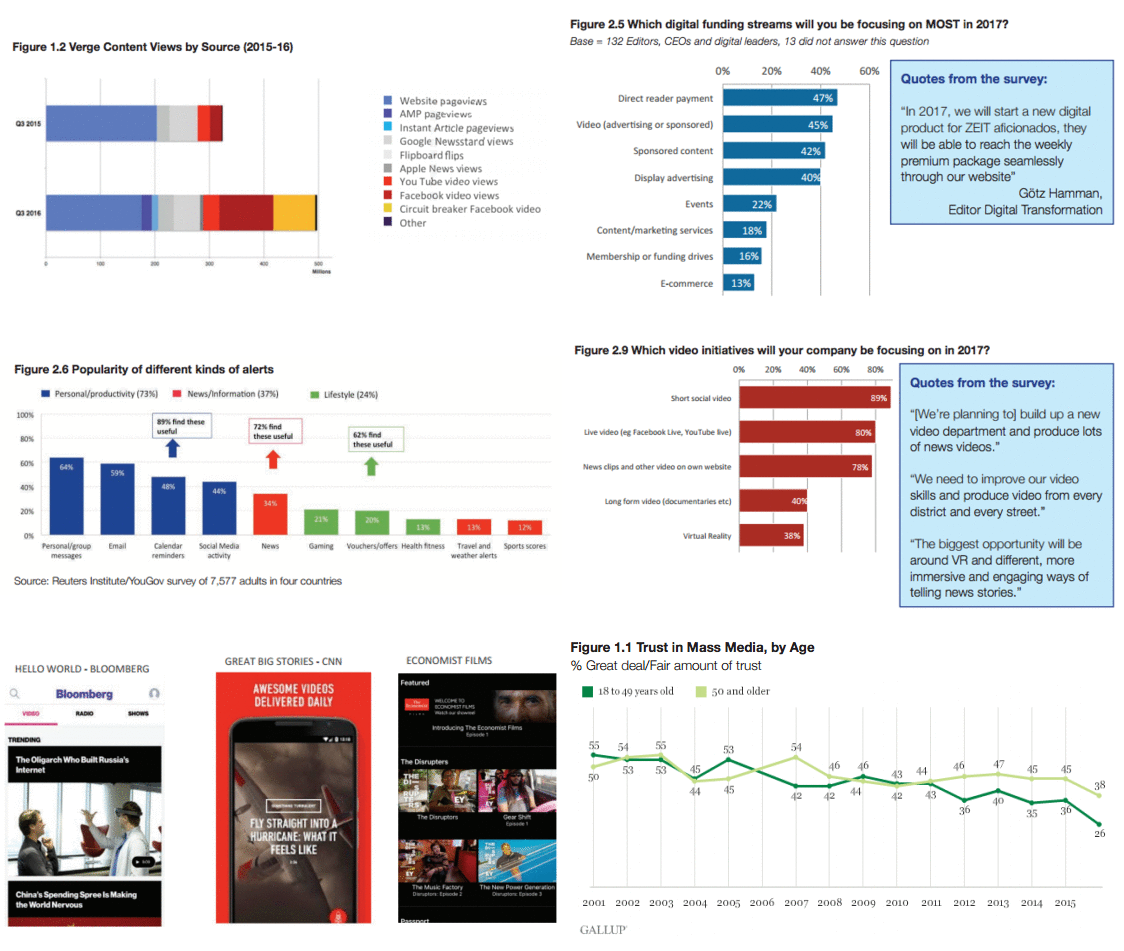
A couple weeks ago I published my responses to Nic Newman’s annual review exercise. Now the resulting report is out (PDF here).

As usual it’s a great roundup of the last 12 months, and some crystal-ball-gazing that will be as interesting historically as it will be for anything it gets right. It includes some particularly good sections on some news organisations’ plans around advertising, membership, and audio.

The funniest bit of the report comes with the statistic that 70% of editors, CEOs and digital leaders surveyed “said worries over the distribution of fake/inaccurate news in social networks will strengthen their position”.

Hm.

trust-in-mass-media-by-age

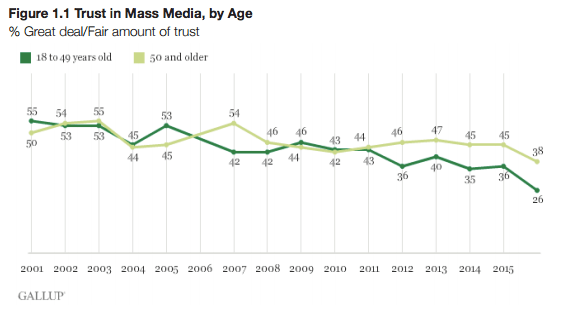
Chart taken from the Digital News Project 2017

NiemanLab already have a decent write up of the report here.

Bursting the filter bubble: The Echo Chamber Club

Social media ‘filter bubbles’ – where users only see news sympathetic with their own views – have been blamed for pretty much everything considered ‘wrong’ with politics, from obscuring Trump’s popularity and encouraging political polarisation to the ‘fake news’ epidemic. New publishing startup Echo Chamber Club offers to burst readers’ filter bubbles and challenge their views — and it’s doing so well that it is already planning to expand. Andrew Brightwell interviews its founder, Alice Thwaite.

The Echo Chamber Club, founded in June 2016, sets out to “help ‘liberal and progressive metropolitans’ understand different points of view for themselves.” It publishes weekly emails, each covering a subject in the news, but offering a perspective directly opposed to the liberal consensus.

Since starting in the wake of the UK’s vote to leave the European Union, it has challenged liberal perceptions on Russia’s support of the Assad regime in Syria, inflation policy, Western military intervention, and the EU referendum. Continue reading

The most-read posts on Online Journalism Blog — and on Medium — in 2016

2016

Rounding up the best posts of the year is a good habit to get into, but one that I’ve failed to acquire. In 2014 – the ten year anniversary of this site – I rounded up the year’s best performing posts, which does give you a flavour of what was happening that year — but I forgot to repeat it for 2015.

Here, then, are some reflections on the 10 pieces which did best in 2016 (there were 100 posts across the year), plus the older posts which keep on giving, and a comparison of some pieces which did far better on Medium than on OJB. Continue reading

Someone asked me about 2016 and 2017. This is what I said

Crystal ball image by Christian R. Hamacher

Crystal ball image by Christian R. Hamacher

Every year Nic Newman asks a bunch of people for their reflections on the last 12 months and their anticipations for the year ahead. Here’s what I’ve said this year — as always, to be taken with significant doses of salt. 

What surprised you most in 2016?

Perhaps the sheer number of significant developments (compare the posts for 2015 and 2014). It was the year when bots went mainstream very quickly, and platforms took further significant steps towards becoming regulated as publishers.

It was a year of renewed innovation in audio. 2016 saw the launch of a number of new audio apps, including Anchor, Pundit, Clyp and Bumpers.fm, as various companies attempted to be the ‘Facebook of audio’. The only problem: Facebook wants to be the Facebook of audio too: at the end of the year they introduced live audio. Continue reading

From Bana and #boycottdelta to gaslighting and AI – why we’re headed for confusion fatigue in 2017

Goodbye 2016, the year of The Boys Who Cried Wolf. Not just a year of ‘fake news’, but something more: a crisis in people’s ability to believe anything.

And in 2017 it’s likely to get worse.

To explain what I mean, you need to go back to 2003, when Salam Pax, the ‘Baghdad Blogger’, was posting updates in the middle of the Iraq War. While some questioned whether he was really based in Iraq, that debate was relatively limited by today’s standards. It was a manageable doubt.

The boys who cried wolf in Aleppo

Cut to Aleppo in 2016 and you see how things have changed. Bana Alabed is perhaps Aleppo’s ‘Baghdad Blogger’: a Twitter account about the experiences of a seven year old Syrian girl, maintained by her mother.

But she is not alone: the number of voices speaking from the ground has proliferated… Continue reading

2016 was the year of the bot — here’s a brief history of how they have been used in journalism

Robot gif

2016 was the year of the bot in journalism. In this edited extract from the forthcoming second edition of the Online Journalism Handbook, I outline what bots are, how bots have been used by media organisations from early Twitter bots to the recent wave of ‘chatbots’, and some tips and tools for getting started with journalistic bots.

‘Bots’ are ‘robots’ – only on the internet. Without the mechanical body of their physical counterparts, all that leaves is a disembodied computer script, normally created to perform repetitive tasks.

This broad description takes in a whole range of activities, and so the term ‘bot’ is used to talk about very different things in different contexts:

  • In search you might talk about bots used to index webpages, such as the ‘Googlebot’.
  • In finance and commerce you might talk about bots used to monitor information online and respond to it by buying or selling things.
  • And in advertising and politics you might talk about bots being used for nefarious purposes: for example, to make it look like more people are viewing webpages, clicking on adverts, or arguing for a particular candidate.

This article isn’t about any of those.

In the context of journalism and publishing, the term ‘bot’ is normally used to refer to something which users can interact with. Examples include: Continue reading

Snapchat for Journalists now available in Spanish

Snapchat para periodistas libro

My ebook Snapchat for Journalists is now available in Spanish: Snapchat para periodistas.

The new translation also includes specific examples from Spanish language media and journalists using the platform.

A Spanish language blog post by Barbara Maseda, with more details about the translation, can be found here.

Barbara has also translated two of my other books into Spanish: Periodismo de datos: Un golpe rápido (Data Journalism Heist) and Excel para periodistas (Excel for Journalists)

Civio and transparency in Spain: “We fight for public access to data”

Javier de la Vega

Javier de la Vega

Spanish citizens are now a step closer to understanding how power operates in the country, and how decisions affect them, thanks to the work of organisations like Civio fighting for transparency and access to public data. In October their work was recognised with the Gabriel Garcia Marquez award in innovative journalism for their investigations Medicamentalia. In a guest post for OJB, Nuria Riquelme Palazón spoke with Javier de la Vega, one of the members of Civio.

Access to public information, accountability and participatory democracy may have been a reality in many countries for some time — but in Spain they sounded like a utopia. Entrepreneur Jacobo Elosua and computer technician David Cabo decided that this had to change.

The pair used their savings to build an organisation with the intention of serving those active citizens who, like them, believed in transparency: Civio Foundation.

Taking inspiration from organisations like mySociety in the UK, Ciudadano Inteligente in Chile and the Sunlight Foundation in the USA, they began the long process in 2011. Continue reading