Tag Archives: automation

Visualisation as an editorial process

In the second part of this extract from a book chapter in the new Routledge Companion to Visual Journalism, I look at the editorial processes involved in data visualisation, along with the ethical considerations and challenges encountered along the way.

Decisions around what data to visualise and how to visualise it involve a range of ethical considerations and challenges, and it is important to emphasise that data visualisation is an editorial process just as much as any other form of factual storytelling.

Journalists and designers employ a range of rhetorical devices to engage an audience and communicate their story, from the choice of the chart and its default views or comparisons, to the use of colour, text and font, and animations and search suggestions (Segel and Heer 2011; Hullman & Diakopoulos 2011).

Chart types are story genres

The chart that a journalist chooses to visualise data plays a key role in suggesting the type of story that is being told, and what the user might do with the data being displayed.

If a pie chart is chosen then this implies that the story is about composition (parts of a whole). In contrast, if a bar chart is used then the story is likely to be about comparison.

Line charts imply that the reader is being invited to see something changing over time, while histograms (where bars are plotted along a continuum, rather than ranked in order of size) invite us to see how something is distributed across a given scale.

Scatterplots — which plot points against two values (such as the cancer rate in each city against the same city’s air pollution) — invite us to see relationships.

Continue reading

AI and “editorial independence”: a risk — or a distraction?

Tools
When you have a hammer does everything look like a nail? Photo by Hunter Haley on Unsplash

TL;DR: By treating AI as a biased actor rather than a tool shaped by human choices, we risk ignoring more fundamental sources of bias within journalism itself. Editorial independence lies in how we manage tools, not which ones we use.

Might AI challenge editorial independence? It’s a suggestion made in some guidance on AI — and I think a flawed one.

Why? Let me count the ways. The first problem is that it contributes to a misunderstanding of how AI works. The second is that it reinforces a potentially superficial understanding of editorial independence and objectivity. But the main danger is it distracts from the broader problems of bias and independence in our own newsrooms.

Continue reading

VIDEO: How automation played a central role in data journalism — and is now playing it again

Automation was key to the work of data journalism pioneers such as Adrian Holovaty — and it’s becoming increasingly central once again. This video, made for students on the MA in Data Journalism at Birmingham City University, explores the variety of roles that automation plays in data journalism; new concepts such as robot journalism, natural language generation (NLG) and structured journalism; and how data journalists’ editorial role becomes “delegated to the future” through the creation of algorithms.

You can find the video about Poligraft, and the FT on robot journalism at those links.

This video is shared as part of a series of video posts.

This is how I’ll be teaching journalism students ChatGPT (and generative AI) next semester

Robot with books
Image by kjpargeter on Freepik

I’m speaking at the Broadcast Journalism Teaching Council‘s summer conference this week about artificial intelligence — specifically generative AI. It’s a deceptively huge area that presents journalism educators with a lot to adapt to in their teaching, so I decided to put those in order of priority.

Each of these priorities could form the basis for part of a class, or a whole module – and you may have a different ranking. But at least you know which one to do first…

Priority 1: Understand how generative AI works

The first challenge in teaching about generative AI is that most people misunderstand what it actually is — so the first priority is to tackle those misunderstandings.

Continue reading

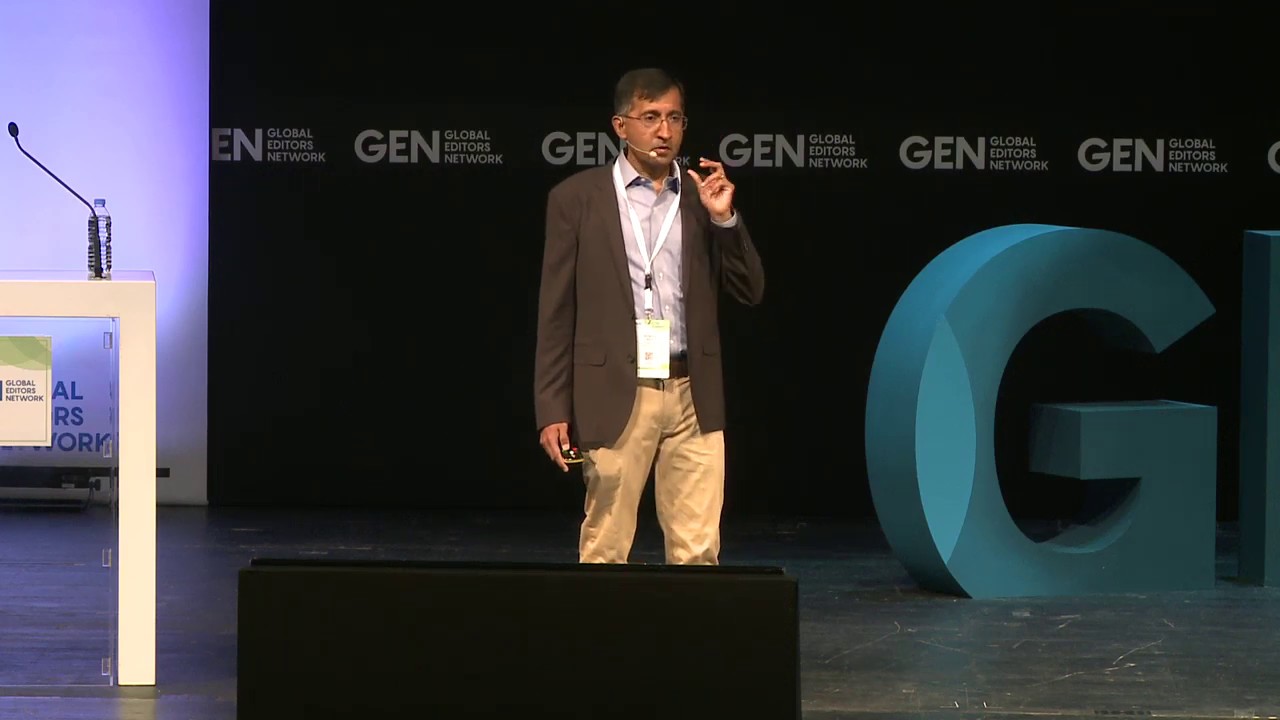
GEN 2019 round-up: 4 videos to watch on the potential of data and AI

Krishna Bharat

This year’s Global Editor’s Network (GEN) Summit, in Athens, Greece, had a big focus on the use of verification and automation. BBC News data scientist and PGCert Data Journalism student Alison Benjamin went along to see what was being said about artificial intelligence (AI), data and technology in the news industry. Here are her highlights…
Continue reading

FAQ: Do you think that an increase in algorithms is leading to a decline in human judgement?

recipe by Phillip Stewart

This algorithm has been quality tested. Image by Phillip Stewart

The latest in my series of FAQ posts follows on from the last one, in response to a question from an MA student at City University who posed the question “Do you think that an increase in algorithmic input is leading to a decline in human judgement?”. Here’s my response.

Does an increase in computation lead to a decline in human input?

Firstly, it’s important to emphasise that the vast majority of data journalism involves no algorithms or automation at all: it’s journalists making calculations, which historically they would have done manually.

You mention the possibility that “an increase in computation leads to a decline in human input”. An analogy would be to ask whether an increase in pencils leads to a decline in human input in art. Continue reading

Here’s the thinking behind my new MA in Data Journalism

A few weeks ago I announced that I was launching a new MA in Data Journalism, and promised that I would write more about the thinking behind it. Here, then, are some of the key ideas underpinning the new course — from coding and storytelling to security and relationships with industry — and how they have informed its development. Continue reading

5 highlights from news:rewired: from live video ethics to mobile data journalism

principal

Photo: Reuters News Agency

In a guest post for OJB, Livia Vieira rounds up some of the highlights of News:Rewired 2017, from best practices to deal with fake news and engagement with live videos, to newsroom automation, mobile data journalism and collaborative storytelling and groundbreaking initiatives in newsrooms. 

1. Engagement and ethics in live social video

According to Alfred Joyner, head of video of IBT Media, 66% of the views on Facebook Live videos happen after they end, so it is important to re-package the content, giving it new meaning.

Alfred also emphasised that IBT trains its anchors and uses high quality equipment to ensure the quality of transmissions — although all speakers hit on the point that Facebook Live is not TV, and so does not need to have that ‘casted’ format. Continue reading

2016 was the year of the bot — here’s a brief history of how they have been used in journalism

Robot gif

2016 was the year of the bot in journalism. In this edited extract from the forthcoming second edition of the Online Journalism Handbook, I outline what bots are, how bots have been used by media organisations from early Twitter bots to the recent wave of ‘chatbots’, and some tips and tools for getting started with journalistic bots.

‘Bots’ are ‘robots’ – only on the internet. Without the mechanical body of their physical counterparts, all that leaves is a disembodied computer script, normally created to perform repetitive tasks.

This broad description takes in a whole range of activities, and so the term ‘bot’ is used to talk about very different things in different contexts:

  • In search you might talk about bots used to index webpages, such as the ‘Googlebot’.
  • In finance and commerce you might talk about bots used to monitor information online and respond to it by buying or selling things.
  • And in advertising and politics you might talk about bots being used for nefarious purposes: for example, to make it look like more people are viewing webpages, clicking on adverts, or arguing for a particular candidate.

This article isn’t about any of those.

In the context of journalism and publishing, the term ‘bot’ is normally used to refer to something which users can interact with. Examples include: Continue reading

The ‘Metajournalist’ and the return of personalised news: research on automated reporting

Matt Carlson has written an interesting piece of research (£) into ‘The Robotic Reporter’: namely, automated journalism where articles are written by algorithms.

His interest lies largely in the “technological drama” of competing narratives and cultures – but along the way he identifies some developments and implications which appear in the minority of reports beyond those recurring stories of “augmentation or elimination” (of journalists’ jobs), but which may be more interesting. Continue reading