Earlier this month I was interviewed for a feature about data journalism in the Argentina newspaper La Nacion. Here are the full questions and answers, in English, published as part of the FAQ series.
Continue reading

Earlier this month I was interviewed for a feature about data journalism in the Argentina newspaper La Nacion. Here are the full questions and answers, in English, published as part of the FAQ series.
Continue readingIn this latest post in the FAQ series, I’ve been asked to help answer a question on the “ethical dilemmas faced by news organisations when considering the use of AI in reporting stories“.
Continue reading
The latest frequently asked questions post focuses on questions from a Masters student interested in the effect of the rise of online news on journalism ethics.
I think the ethics of journalism have changed, yes, for a range of reasons, and in both negative and positive ways. For example, transparency has become much more highly valued as a journalistic value: journalists are expected to earn the trust of readers much more than was previously the case, and I would argue that is a positive development. Linking to sources, sharing methodologies, etc. forces journalists to hold themselves to higher standards. Continue reading
The latest frequently asked questions post comes in response to a PhD student looking at data journalism and gatekeeping. Here are the questions and my answers:
Journalists and news organisations have both been forced to adapt by the increased competition, and the changing nature of the world that we report on (i.e. the fact that it is more data-driven).
Many publishers tell me they want to give their journalists data skills because they feel that they need to ‘up their game’ in order to compete with new entrants to the sector, and to create distinctive content in an environment where celebrities, politicians, sportspeople etc. all publish direct to audiences rather than via media. Continue reading

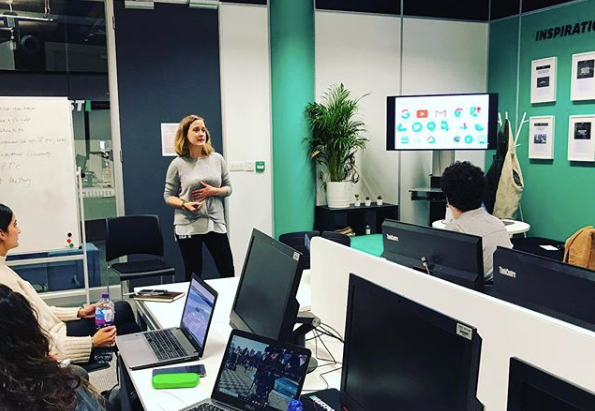
Abigail Edge teaches a guest workshop on advanced Google tools in BCU’s newsroom
The latest frequently asked questions post is an answer to Ian Silvera who asks a number of questions about teaching journalism within the context a fast-changing industry. You can read his post here.
Following the industry press is pretty essential for anyone teaching in the field. Sites like Journalism.co.uk and Niemanlab are especially good at covering developments, but there’s also InPublishing and HoldtheFrontPage who cover it more broadly including new technologies and issues. And tons of email newsletters.
It’s easier than ever to follow individuals inside the industry, too – on Twitter as well as professional blogs, Medium.com and anywhere else. I maintain Twitter lists of people reporting in particular fields or in particular roles, for example, and generate Nuzzel newsletters for those lists so I’m up to date with what they’re sharing. Continue reading

This is what you’ll look like after reading all of these books… (“Study of a Man Reading” by Alphonse Legros)
This latest in the frequently asked questions series is an answer to an aspiring data journalism student who asks “Would you be able to direct me to any resources or text books that might help [prepare]?” Here are some recommendations I give to students on my MA in Data Journalism…
Data journalism isn’t just the application of a practical skill, but a profession with a culture, a history, and non-technical practices.
For that reason probably the first thing to recommend is not a book, but just general reading (and listening and watching) as much data journalism, and journalism generally, as possible. These mailing lists (and these) are a good start, and following data journalists on Twitter, and the hashtag #ddj, will expose you to the debates taking place in the industry. Continue reading

Recognising patterns is a key skill in computational journalism (image by Stanley Zimny)
This latest group of frequently asked questions comes from an interview with Source, published here in full just in case it’s — you know — useful or something…
Firstly, an ability to recognise patterns, or structured information. Spreadsheets are explicitly ‘data’ but some of the most interesting applications of computational journalism are where someone has seen data where others don’t.

Tools image by Lachlan Donald
This latest set of frequently asked questions comes from a MA student at Coventry University who is researching Instagram. Their questions revolve around the impact of social media on journalism and Instagram in particular.
There’s a lot of scope in that question so in breaking it down it’s firstly worth making a distinction between apps (i.e. tools, used by producers to capture, publish and share) and platforms (i.e. a place where content is hosted).
So for example Instagram is a platform that hosts content which can be accessed on a tablet, or on mobile, or a desktop or laptop computer, but can also be published to through an app on mobile or tablet. Continue reading

This algorithm has been quality tested. Image by Phillip Stewart
The latest in my series of FAQ posts follows on from the last one, in response to a question from an MA student at City University who posed the question “Do you think that an increase in algorithmic input is leading to a decline in human judgement?”. Here’s my response.
Firstly, it’s important to emphasise that the vast majority of data journalism involves no algorithms or automation at all: it’s journalists making calculations, which historically they would have done manually.
You mention the possibility that “an increase in computation leads to a decline in human input”. An analogy would be to ask whether an increase in pencils leads to a decline in human input in art. Continue reading
The latest in my series of FAQ posts comes in response to questions from a number of MA students at City University who emailed to ask “Can data journalism improve the world?”. Here’s my response, along with some follow-up questions and answers.
I wouldn’t be involved in data journalism if I didn’t think it could improve the world! But more broadly, I think journalism as a whole improves the world, whether that’s data journalism or not. (In fact, the whole reason I got involved in data journalism was because I believed it had the biggest potential to help journalism – particularly investigative journalsm – and, by extension, improve the world.) Continue reading