Category Archives: online journalism

“I tried to deal with numbers as professionally as I could. But behind them there were people, and I couldn’t run away from it” — Ferran Morales on visualising refugee data

In a guest post for OJB Maria Crosas interviews Ferran Morales, the journalist behind The Story of Zainab, to understand how he tackled the challenge of processing and visualising data about refugees.
ferran

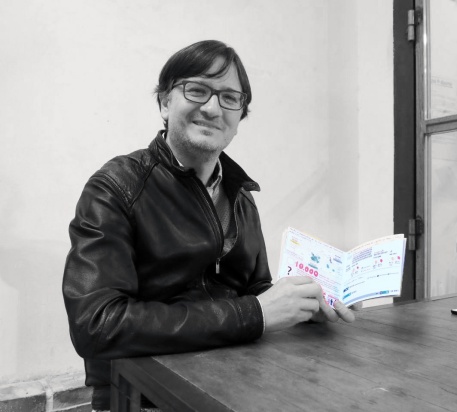
Ferran Morales showing infographics from Zainab’ story

Ferran Morales is a data journalist and graphic designer at El Mundo Deportivo. In February, with the team at Media Lab Prado, he published The Story of Zainab, a data-driven narrative following an 11-year-old refugee and her family, that had to leave their home in 2011 because of the war in Syria.

The project was created as part of Visualizar 2017, a workshop for prototyping data visualisation projects, and drew on data on refugees.
Continue reading

3 weeks left to enter the Data Journalism Awards

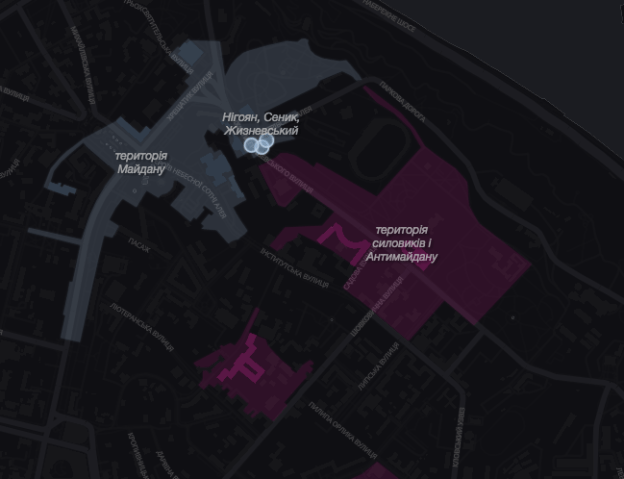
maidan revolution map

One of the projects from last year’s winning portfolio in the young data journalist category

The deadline for the Data Journalism Awards is now just 3 weeks away. One category for educators and young journalists to look out for is the ‘Student and young data journalist of the year‘ which seeks to shine a light “the outstanding work of a new talent in data journalism, for projects done while they are still studying or early in their professional careers.”

The category is open to all data journalists under the age of 27 — but not students over that age (who I’m told should apply for the Best Individual Portfolio category). Submissions can include one or as many as ten pieces of data journalism. Winners get $1801 (the year William Playfair reportedly created the pie chart) and a trophy.

Last year’s winner Yaryna Serkez won for a portfolio that included a reconstruction of the last three days of the Ukraine’s 2014 Maidan revolution, the Snow Fall-esque “Anatomy of the Carpathians“, and a network analysis of pro-Russian trolls on Facebook in Ukraine.

There are also some new categories: Innovation in data journalism, and Best data journalism team. More on the website.


Continue reading

Text-as-data journalism? Highlights from a decade of SOTU speech coverage

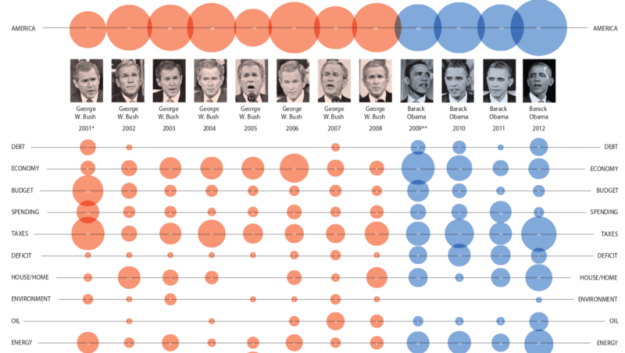
January 2012: The National Post’s graphics team analyzes keywords used in State of the Union addresses by presidents Bush and Obama / Image: © Richard Johnson/The National Post

January 2012: The National Post’s graphics team analyzes keywords used in State of the Union addresses by presidents Bush and Obama / Image: © Richard Johnson/The National Post

In a guest post for OJB, Barbara Maseda looks at how the media has used text-as-data to cover State of the Union addresses over the last decade.

State of the Union (SOTU) addresses are amply covered by the media —from traditional news reports and full transcripts, to summaries and highlights. But like other events involving speeches, SOTU addresses are also analyzable using natural language processing (NLP) techniques to identify and extract newsworthy patterns.

Every year, a new speech is added to this small collection of texts, which some newsrooms process to add a fresh angle to the avalanche of coverage.

Continue reading

What do journalists do with large amounts of text?

books

Photo: Pixabay

Barbara Maseda is on a John S. Knight Journalism Fellowship project at Stanford University, where she is working on designing text processing solutions for journalists. In a special guest post she explains what she’s found so far — and why she needs your help.

Over the last few months, I have been talking to journalists about their trials and tribulations with textual sources, trying to get as detailed a picture as possible of their processes, namely:

  • how and in what format they obtain the text,
  • how they find newsworthy information in the documents,
  • using what tools,
  • for what kinds of stories,

…among other details.

What I’ve found so far is fascinating: from tech-savvy reporters who write their own code when they need to analyze a text collection, to old-school investigative journalists convinced that printing and highlighting are the most reliable and effective options — and many shades of approaches in between.

What’s your experience?

If you’ve ever dug a story out of a pile of text, please let me know using this questionnaire. It doesn’t matter if you’ve used more or less sophisticated tools to do it.

Here are a few reasons and incentives to contribute: Continue reading

Building the first central database of victims of the Spanish Civil War and the Franco regime

Bombings in Barcelona in 1938

Bombings in Barcelona in 1938 (Image by Italian Airforce under CC)

In a guest post for OJB, Carla Pedret looks at a new data journalism project to catalogue what happened during the Spanish Civil War.

125,000 people died, disappeared or were repressed in the Spanish Civil War (1936-1939) and during the Franco dictatorship, according to historians. Many of their families still do not know, 40 years later, what exactly happened to them.

Now the Innovation and Human Rights (IHR) association has created the first central database of casualties, missing persons and reprisals during the Spanish Civil War and under Francoism.

Continue reading

Now available under Creative Commons: my book chapter on data journalism

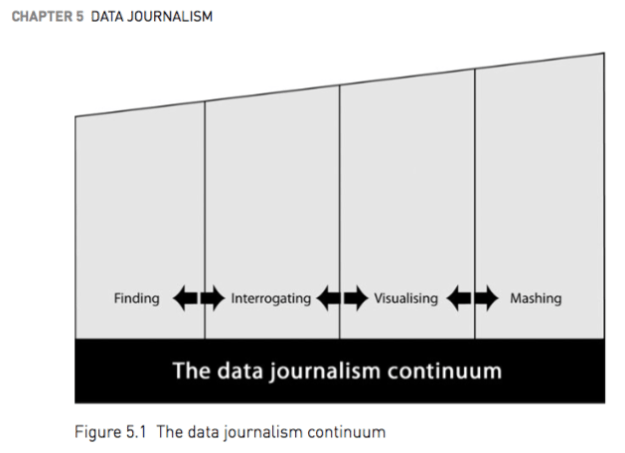
Finding, interrogating, visualising, mashing

The data journalism continuum from the first edition of the Online Journalism Handbook

When I agreed to write the second edition of the Online Journalism Handbook, I asked that the chapter on data journalism from the 2011 edition of the book be released under a Creative Commons licence. To Routledge’s credit, they agreed. Here, then, I’m making that book chapter available — you can download it from here or access it on Slideshare (embedded below).

It’s always difficult to get publishers to agree to things like this, so if you have any comments or feedback that I can use to make a similar case to publishers in future, please let me know in the comments.

The work is licensed under a Creative Commons Attribution-NonCommercial-ShareAlike 4.0 International License.

Creative Commons Licence

What changed in 2017 — and what we can expect in 2018 (maybe)

Because he sends me an email every December, Nic Newmanhas a tag all of his own on this blog. So as this year’s email lands in my inbox here’s my annual reply around what I’ve noticed in the last 12 months — along with some inevitably doomed predictions of what might happen in the next year…

Surprising in 2017: horizontal storytelling and Facebook disappointments

The rapid spread of horizontal storytelling (‘tap to advance’) struck me particularly this year. 2017 saw it become the default for new launches, from Facebook’s new ‘Messenger Day‘ feature and Medium’s Series, to Instagram‘s Carousel feature and WhatsApp‘s Status feature, while the BBC news app’s videos of the day feature used the same approach too. Continue reading

All my data journalism ebooks are $5 or less this Christmas

data journalism books

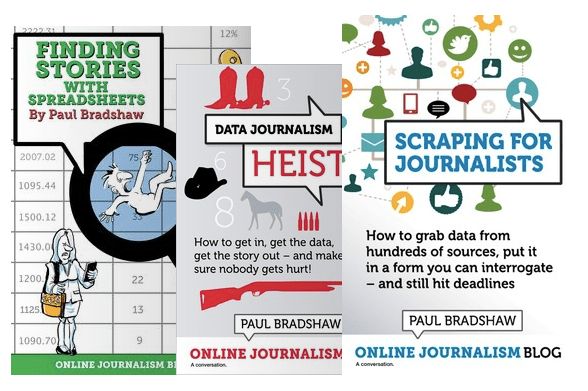
The prices of my 3 data journalism ebooks — Data Journalism Heist, Finding Stories in Spreadsheets and Scraping for Journalists — have been cut to $5 on Leanpub in the lead up to Christmas. And if you want to get all 3, you can also get the data journalism books bundle on Leanpub for more than half price over the same period, at $13. Get them while it lasts!

How we did it: investigating Nigerian football agents

Last year I was part of a team — with Yemisi Akinbobola and  Ogechi Ekeanyawu — that won a CNN MultiChoice African Journalist of the Year award for an investigation into Nigerian football agents. The project, funded by Journalismfund.eu, and also available in an immersive longform version, combined data journalism and networked production with on-the-ground reporting. Here are some of the lessons we drew from the project… Continue reading

Data journalism’s AI opportunity: the 3 different types of machine learning & how they have already been used

I understand that you want me to explain how Ava works (from Ex Machina)

This week I’m rounding off the first semester of classes on the new MA in Data Journalism with a session on artificial intelligence (AI) and machine learning. Machine learning is a subset of AI — and an area which holds enormous potential for journalism, both as a tool and as a subject for journalistic scrutiny.

So I thought I would share part of the class here, showing some examples of how the 3 types of machine learning — supervised, unsupervised, and reinforcement — have already been used for journalistic purposes, and using those to explain what those are along the way. Continue reading