The book is an introduction to data journalism and two simple techniques in particular: finding story leads using pivot tables and advanced filters.
The book also covers useful sources of data, how to follow leads up, and how to tell the resulting story.
You can also buy it from Leanpub, where it’s been live for a couple months now and is available in PDF, mobi and ePub formats. Comments welcome as always.
The latest in our series of Hyperlocal Voices sees Damian Radcliffe talk to David Williams, co-founder of MyTown Media Ltd, which runs four hyperlocal websites in Wales.
When were the sites launched?
After about six months of fact finding and market research, the first site – MyWelshpool – was launched on Friday 13th, August 2010. Luckily it has been far from a horror story since!
I had moved back to the UK after many years in the Middle East and it didn’t take long to realise that the impact of the traditional local media was diminishing, not just in Mid Wales but across the UK.
Newspaper sales were dropping as readers turned to the internet for their news and information. Continue reading →
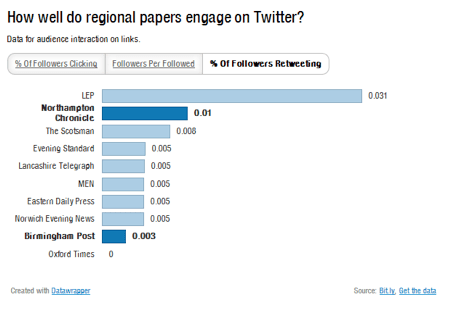
Regional newspapers on Twitter – percentage of followers retweeting – click for interactive version
Newspaper Twitter accounts with the highest click-through rates tend to follow more people, customise tweets for Twitter and engage in more conversation, according to an analysis by Patrick Scott in the first of a series of three posts.
The number of followers a Twitter account has is often assumed to be representative of the influence they command. But is it what we should be measuring? Continue reading →
All this week I am publishing examples of legal dilemmas that a journalism student might face (Read my previous post on students being publishers, and the responsibilities that come with that for the background). I can’t promise a ‘right answer’ at the end of the week – but I hope you can comment on what a student publisher might do – and why. Here’s the fourth – probably the most complex of the lot:
Case 4: your Facebook page starts getting some nasty comments
You run a Facebook page for a university society group, publishing news about what the group is doing, links to relevant events, and how-tos.
One week, while you are on holiday, a series of hateful comments appear on the site, all from different accounts.
One is a joke by Member A about Jews which many commenters think is sick.
In response, Member B says that all Muslims should be beaten up on sight;
A further comment by Member C adds “homosexuals” to the list for the same treatment;
And for good measure Member D says “Polacks” should be beaten up too – although you know the commenter personally and think the term was used in a tongue-in-cheek fashion (given the timestamp you suspect she was under the influence).
A few days later Member E messages you directly to tell you about those messages, and ask that two commenters be kicked off the page.
To complicate things further, it isn’t the first time that Member E has asked you to kick people off the page – they have been arguing both privately and publicly on the page that a number of openly gay people are trying to ‘hijack’ the group and openly gay members should not be allowed to join it.
The questions
What are the legal issues here – and what tests need to be met for them to be an issue?
Something that infuriates me often with government datasets is the promiscuous heading. This is when a spreadsheet doesn’t just have its headings across one row, but instead splits them across two, three or more rows.
To make matters worse, there are often also extra rows before the headings explaining the spreadsheet more generally. Here’s just one offender from the ONS:
A spreadsheet with promiscuous headings
To clean this up in Excel takes several steps – but Open Refine (formerly Google Refine) does this much more quickly. In this post I’m going to walk through the five minute process there that can save you unnecessary effort in Excel. Continue reading →
A few days ago, my English colleague Paul Bradshaw wrote a piece “There’s no such thing as a ‘student journalist’” on his Online Journalism blog. He argues that there should be no distinction between journalists or students of journalism (presumably training to be employed as journalists after graduation) because they are both publishers of information and the students carry out the actions of journalists — they are effectively “doing” journalism — while they learn the skills, technologies and attitudes of the profession.
Students are experiencing first hand the culture of journalism, the experience of journalism and the social consequences of what they do. Paul writes:
There is no such thing as a ‘student journalist’.
Students of journalism no longer practise their work in the seclusion of a classroom. They do not write solely for lecturers, or even for each other.
Even if their course provides no opportunities to do any of these things, they will have Twitter accounts, or Facebook accounts.
All of which means that they are publishers.
I don’t disagree with this in principle. Certainly any journalism course worthy of the name would be requiring students to participate in what I like to call “live fire” news exercises. These are usually done under close supervision. However, writing a blog as part of coursework (and for many students it is an onerous requirement of their study, rather than something they enjoy or immediately see the benefits of) is not journalism. Blogging is not journalism and I thought that debate was settled years ago. Continue reading →
Kathy Gill has written a rather wonderful post about the public service responsibilities of journalists educated with public money. It’s worth reading in full (that summary doesn’t do it justice) – and I wanted to add my own experiences around a change in journalism education which I only realised a few years ago.
It is often overlooked when people talk about journalism and media degrees that many students realise during the course of their studies that the journalism profession is not for them.
It might be the pay (it often is the pay), the culture, the conflict between perception and reality, or simply that they discover something else they enjoy even more.
For others, the decision is a forced one: circumstances take them into another career – often, again, because the pay in journalism is not enough, either to raise a family on, or to persuade them to switch from the job they got ‘until I break into the media industry’.
All of those people may not be professional journalists, but they remain citizens, and the skills they learned in their studies are there, waiting to be activated.
When they become parents, and they have concerns about the way their child’s school is governed.
When they or their loved ones become ill, and they want to ask why they were not treated with dignity.
When their local community is under threat from development – or the lack of it.
When they or their loved ones are subject to power exercised without responsibility.
It is easy as a lecturer to mentally write off students who ‘will never make it’ in journalism as a profession. But that ignores a broader responsibility: they will always be citizens.
As a society we rely on those people to tell us their stories, to scrutinise power, to suggest the questions that might be asked, and to raise the alarm.
Martin Hirst touches on these issues in his response to my own Carnival of Journalism post, and he’s right: the have a duty of care to teach not only journalists, but citizens too.
The Carnival of Journalism is back, and this month is looking at student media. That gives me an excuse to talk about something I seem to find myself ranting every year: “You are not student journalists”.
Even if their course provides no opportunities to do any of these things, they will have Twitter accounts, or Facebook accounts.
All of which means that they are publishers.
Ignorance is bliss?
Describing yourself as a student journalist suggests that you haven’t noticed this.
But worse, it reinforces a similar ignorance in the people you talk to as you go about your business.
These are the press officers that say “We don’t deal with student journalists” and the election officers who stop you at the doors of the count – but also the sources who say “I didn’t realise what I said was going to be published.”
Journalism students need to be honest with the latter and forceful with the former. A large part of that means making a mental shift from ‘this is just an exercise’ to ‘this is a real story with real implications’. In other words that move from ‘I am a student’ to ‘I am a journalist-publisher’.
Not just an exercise
For a start, as a publisher you have to be aware of contempt of court, libel, and copyright. This is not an option – and the number one reason you can never think your work is ‘just an exercise’.
You also have to think about syndication: who you might supply your content to. I encourage my students to work as freelancers, and often put them in touch with different news organisations depending on the story.
So there is no such thing as a student journalist. There are only publishers, and non-publishers. Your story can be seen by a million people, or only one – but you should always prepare for the former. As should the press officers. And your sources.
So change that Twitter biography; that About page. And take your job seriously: because if you don’t, no one else will.
“In my view, if we do not acknowledge the student status of our students (no, that’s not a tautology), we are not being diligent in our duty of care (the pastoral role of all teachers at all levels) to ensure that we “first do no harm”. Yes, we have to, as Paul rightly points out, engage our students in the daily routines and socialisation of newsroom practice and we have to move beyond the newsroom model too; but in doing so, we have to be constantly mindful that our pupils must be kept safe.”
“Student journalists who are not afforded the rights of citizens nor the rights of journalists must be given some protection. Thus, it is important we acknowledge their actions may transcend their status – whatever it may be.”
Journalists already learn to code. In the UK they learn shorthand – possibly the most esoteric code there ever was. We also learn a particular coding language: English. This language is taught in schools and involves using a series of 26 characters to encode objects, actions, and descriptions. You may have a similar language you have to learn in your own country. What a drag.
Why do we learn these languages? To save time, and to improve accuracy – two things that should be important to every journalist. Continue reading →
Yesterday an 18-year-old journalism student told me he’d deleted his entire Twitter history using TweetDelete. The same day I noticed that another had changed his Twitter username to remove a reference to Newcastle United.
I was not an innocent bystander – I have to admit: I’d sort of advised them to do this…
Full circle in five years
Some history: I’ve been training journalists and student journalists to use Twitter for almost five years now, and have seen an enormous shift in that time.
In those early classes – between 2008 and 2010 – the difficulty was getting people to write more informally: almost no one had a Twitter account, so they approached it as a professional tool, with professionalism very much in mind.
By the third year, however, things were starting to change. By then around half would typically have pre-existing Twitter accounts, and many were using them in a personal capacity. The problem was not using Twitter in the first place, but how to combine the professional with the personal. “Should I have a different account for personal use?” Yes, I used to say.
Now I don’t.
There’s no such thing as a personal Twitter account
I no longer suggest having separate professional and personal accounts because, aside from the difficulty of running two accounts, frankly there is no such thing as a truly personal, even private, account if you are a journalist.
Some manage the balance: Joanna Geary, who maintains @guardianJoanna and @joannaGeary, springs to mind. But Joanna is able to do that because her ‘personal’ account is barely distinguishable from her ‘work’ account: she acts professionally; she talks about things that interest many of the same people who follow her ‘professionally’.
Joanna, in other words, is the exception.
In the movement from one audience (close friends) to another (strangers who may be judging our credibility as reporters) the harsh truth is that we will be judged unfairly against a standard we never anticipated.
And so I ended up showing TweetDelete to a class of 18-year-olds.
And I only had to mention SnapChat, and sexting for them to get it.
Welcome to the world of permanence. Please keep an eye on your past. For the sake of convenience, you may want to delete it (at least TweetDelete will give you an archived copy).
Note: Ross Hawkes has a fascinating exercise on the same subject: he will find tweets by members of the class and present them back to the class with the name removed. What would they think? “But it’s out of context!” Exactly.






 Online Journalism Blog