Hyperlocal Voices Revisited: Ray Duffill, Hedon Blog

Ray Duffill originally took part in our Hyperlocal Voices series in November 2010. Still going strong three years later, Damian Radcliffe took the opportunity to see what’s changed during that time in this particular patch of East Yorkshire. (Photo credit: Neil Holmes via Flickr)

1. What’s been the biggest change to the site in the last 3 years?

The Hedon Blog has had an annual facelift and theme change each year of its existence, but the last theme change concentrated on highlighting news content (with more photos and visual impact), rather than being just about listing links to useful information. Continue reading

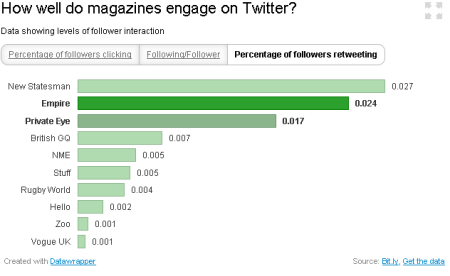
Magazines on Twitter: who has the most click throughs – and why?

Magazines on Twitter - percentage of followers retweeting

Magazines on Twitter – percentage of followers retweeting – click for interactive version

Magazine Twitter accounts with the highest click-through rates tend to be aimed more directly at the reader and to give the reader a clearly defined reason to engage, according to an analysis by Patrick Scott in the second of a series of three posts.

When analysing the engagement on the Twitter accounts of regional newspapers we saw that one of the key factors was how conversational the newspaper was with its followers. But does this still apply when dealing with national publications? Continue reading

Data journalism ebook now on Amazon’s Kindle Store

Data journalism book Data Journalism Heist

My short ebook Data Journalism Heist is now available on Amazon for Kindle (US link here – also available on other countries’ Amazon sites).

The book is an introduction to data journalism and two simple techniques in particular: finding story leads using pivot tables and advanced filters.

The book also covers useful sources of data, how to follow leads up, and how to tell the resulting story.

You can also buy it from Leanpub, where it’s been live for a couple months now and is available in PDF, mobi and ePub formats. Comments welcome as always.

Hyperlocal Voices: David Williams, MyTown Media

The latest in our series of Hyperlocal Voices sees Damian Radcliffe talk to David Williams, co-founder of MyTown Media Ltd, which runs four hyperlocal websites in Wales.

welshpool

  1. When were the sites launched?

After about six months of fact finding and market research, the first site – MyWelshpool – was launched on Friday 13th, August 2010. Luckily it has been far from a horror story since!

MyNewtown followed in December that year and then MyBrecon and MyRadnor joined the portfolio in 2012.

  1. What made you decide to set up the sites?

I had moved back to the UK after many years in the Middle East and it didn’t take long to realise that the impact of the traditional local media was diminishing, not just in Mid Wales but across the UK.

Newspaper sales were dropping as readers turned to the internet for their news and information. Continue reading

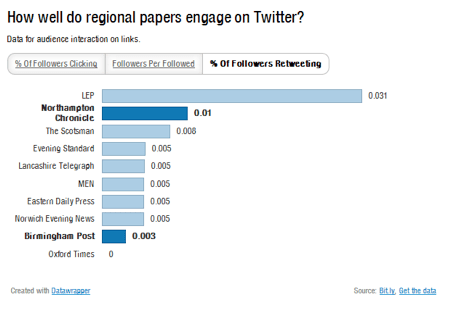
Newspapers on Twitter: who has the most click-throughs – and why?

Regional newspapers on Twitter - percentage of followers retweeting

Regional newspapers on Twitter – percentage of followers retweeting – click for interactive version

Newspaper Twitter accounts with the highest click-through rates tend to follow more people, customise tweets for Twitter and engage in more conversation, according to an analysis by Patrick Scott in the first of a series of three posts.

The number of followers a Twitter account has is often assumed to be representative of the influence they command. But is it what we should be measuring? Continue reading

Test your online journalism law: 5 – witness to a fatal beating

Every day this week I have been publishing an example of a legal dilemma that might face a journalism student (why? Read my previous post on students being publishers, and the responsibilities that come with that). I can’t promise a ‘right answer’ at the end of the week – but I hope you can comment on what a student publisher might do – and why.

Case 5: Your friend witnesses a fatal beating

This isn’t a particularly nice story. Your source tells you that last night she saw a man being beaten so badly that he died afterwards.

You ask questions about where the attack took place, the victim, the attackers, and what was said and done during the attack.

You decide to write a story from what she has told you.

The questions

  1. What are the legal issues here – and what tests need to be met for them to be an issue?
  2. What defence(s) could you mount?
  3. How likely is it that legal action would result?
  4. Would you publish – and why?

Test your online journalism law: 4 – nasty comments on your Facebook page

All this week I am publishing examples of legal dilemmas that a journalism student might face (Read my previous post on students being publishers, and the responsibilities that come with that for the background). I can’t promise a ‘right answer’ at the end of the week – but I hope you can comment on what a student publisher might do – and why. Here’s the fourth – probably the most complex of the lot:

Case 4: your Facebook page starts getting some nasty comments

You run a Facebook page for a university society group, publishing news about what the group is doing, links to relevant events, and how-tos.

One week, while you are on holiday, a series of hateful comments appear on the site, all from different accounts.

  • One is a joke by Member A about Jews which many commenters think is sick.
  • In response, Member B says that all Muslims should be beaten up on sight;
  • A further comment by Member C adds “homosexuals” to the list for the same treatment;
  • And for good measure Member D says “Polacks” should be beaten up too – although you know the commenter personally and think the term was used in a tongue-in-cheek fashion (given the timestamp you suspect she was under the influence).

A few days later Member E messages you directly to tell you about those messages, and ask that two commenters be kicked off the page.

To complicate things further, it isn’t the first time that Member E has asked you to kick people off the page – they have been arguing both privately and publicly on the page that a number of openly gay people are trying to ‘hijack’ the group and openly gay members should not be allowed to join it.

The questions

  1. What are the legal issues here – and what tests need to be met for them to be an issue?
  2. What defence could you mount?
  3. How likely is it that legal action would result?
  4. Would you publish – and why?

Test your online journalism law: 3 – magistrate criticises police

Every day this week I am publishing an example of a legal dilemma that a journalism student might face (why? Read my previous post on students being publishers, and the responsibilities that come with that). I can’t promise a ‘right answer’ at the end of the week – but I hope you can comment on what a student publisher might do – and why.

Case 3: Judge criticises heavy handed police

Here’s another true story. You are attending magistrate’s court in your search for stories. One case related to a breach of bail conditions.

As the defendant hadn’t reported to a police station as required, seven police officers went to his house to find out why. 

The magistrate questioned why it had taken so many police.

“Clearly there is no crime in Heretown if so many police could be spared.”

The defendant was put on an electronic tag instead.

You decide to write a story along the lines of ‘magistrate criticises police’ against the background of the case.

The questions

  1. What are the legal issues here – and what tests need to be met for them to be an issue?
  2. Would you publish – and why?

‘Answers’ and discussion in the comments


Test your online journalism law: 2 – the celebrity visit without pictures

Every day this week I am publishing an example of a legal dilemma that a journalism student might face (why? Read my previous post on students being publishers, and the responsibilities that come with that). I can’t promise a ‘right answer’ at the end of the week – but I hope you can comment on what a student publisher might do – and why.

Case 2: Celebrity visit – and you don’t have pictures

This is a true story. A fire drill has just ended, and as you’re walking back to the classroom you think you see a famous rugby player in the crowd. Your friend says “Nah, it’s not him”.

Like a good journalist, you don’t accept that, so you go to the university reception to ask if Famous Rugby Player is indeed around today. Yes, they say, he is.

Apparently he’s promoting a healthy eating scheme – and also looking at a new piece of kit designed by the health faculty.

You get the details of what he’s doing there, and where he will be when, make a quick call to your editor, and then chase off to find him.

Once there, you interview him, a marketing rep from the company paying him, and a representative from the health faculty.

But your phone runs out of battery – so you have no photos.

As you get back to the newsroom, Famous Rugby Star’s visit is already all over Twitter.

You want to get this story up on your blog before the local newspaper – but a celebrity story is nothing without images.

Thankfully, a few of those tweeting about the visit have taken snaps. Also, one has uploaded some brief video footage to YouTube, and embedding is enabled.

Meanwhile, you have emailed the marketing rep and the health faculty rep for images – both have been promised, but you have no idea how long it will take.

The questions

  1. What are the legal issues here – and what tests need to be met for them to be an issue (or not)?
  2. What defence could you mount?
  3. How likely is it that legal action would result?
  4. Would you publish – and why?

‘Answers’ and discussion in the comments

Test your online journalism law: 1 – the food that should have been binned

All this week I am going to be publishing examples of legal dilemmas that a journalism student might face (Read my previous post on students being publishers, and the responsibilities that come with that for the background). I’ll be using the hashtag #ojblaw throughout and live tweeting a discussion on Friday 10-12 UK time.

I hope you can comment on what a student publisher might do – and why.

Here’s the first:

Case 1: major fast food outlet selling food it should have binned

It is 4am and you are sat with a friend in a fast food chain outlet. This is a well known, global brand – you can choose either McDonalds or Burger King, because these things matter.

Your friend works for the same company, in another city. She turns to you and says:

“That food should have been thrown away two hours ago.”

She knows because she can see the timestamps on the food packaging behind the counter.

The next day you prepare to write up a news article about this.

You find some useful background: the company has published its own policy on how long food should be kept out, for example. You also have the Food Standards Agency report for the outlet (it was satisfactory).

Your headline reports just what your friend said: that the particular outlet was serving food that was hours old, and breaking its own guidelines in the process.

You have a quote from your friend, who is named, and her position as an employee of the fast food chain is mentioned. She is fine with this.

You seek a reaction from both the outlet and the fast food chain’s central office. Both refuse to comment, and you have included that in your article.

The questions

  1. What are the legal issues here – and what tests need to be met for them to be an issue?
  2. What defence could you mount?
  3. How likely is it that legal action would result?
  4. Would you publish – and why?

‘Answers’ and discussion in the comments