Over on the BBC Academy blog I’ve written about 3 problems with source protection, and 3 things we can do about it.
Meanwhile there’s now only 10 places left on the event I’ve organised on these issues on November 6: register here.
Over on the BBC Academy blog I’ve written about 3 problems with source protection, and 3 things we can do about it.
Meanwhile there’s now only 10 places left on the event I’ve organised on these issues on November 6: register here.

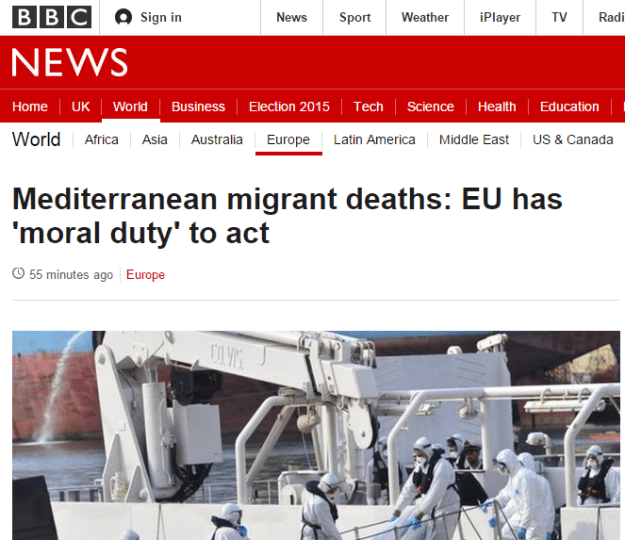
Someone, somewhere, ought to be doing some research on the increasing use of the colon in news article headlines online. That simple character has already become the go-to option when it comes to fixing your headline for search engine optimisation (SEO).
One of the ‘rules’ of SEO is to make sure you get key words in your headline. A second rule is to try to get those words at the front of your headline.
The colon allows you to do both.
Here are just a few examples: Continue reading

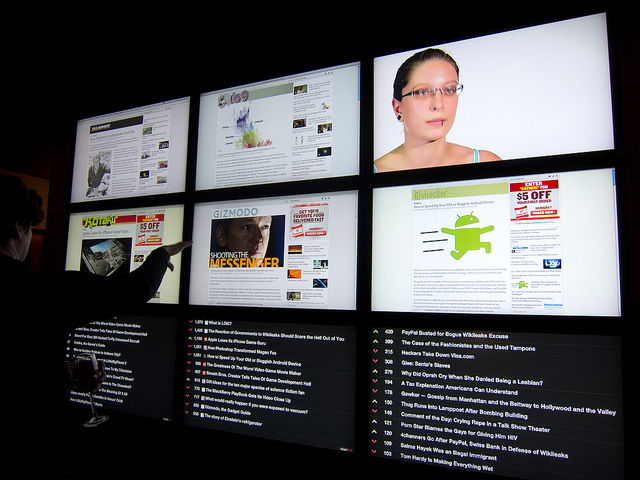
photo by Scott Beale / Laughing Squid
As I introduce the day I will be thinking about two pieces of data in particular: research by the Tow Center’s Caitlin Petre into the use of Chartbeat; and Checking, Sharing, Clicking and Linking, a piece of research into consumption. Continue reading

Curly brackets pattern by Dan McCullough
One of the most useful applications of the data cleaning tool Open Refine (formerly Google Refine) is converting XML and JSON files into spreadsheets that you can interrogate in Excel.
Surprisingly, I’ve never blogged about it. Until now. Continue reading

The list already boasts journalists from some of the leading data journalism projects in Latin America
A new data journalism mailing list for Spanish speakers has been launched by The National Institute for Computer-Assisted Reporting (NICAR) and its parent organisation, Investigative Reporters and Editors (IRE), reports Barbara Maseda.
NICAR-ESP-L, as it is called, seeks to be the Spanish version of NICAR-L, a mailing list in English that has been active for over 20 years. Continue reading
So, the commission that has been formed to look into Freedom of Information in the UK is worrying a lot of people, particularly journalists. From the selection of its members and lack of transparency to suggestions of vetoes and charges, there’s a strong signal of an intention to curtail the ‘free’ in ‘freedom’.
But there is an opportunity to have an input into the commission, through its call for evidence. This not only allows you to send your opinions on improving FOI to the commission via email, but also has an online form you can fill in.
If you take the form route there are 2 key questions:
Whether you think it’s a foregone conclusion or not, this is a key opportunity to have a shot.
Una nueva lista de correos en español dedicada al periodismo de datos ha sido puesta en marcha por el Instituto Nacional de Periodismo Asistido por Computadora (NICAR) y su organización madre, Reporteros y Editores de Investigación (IRE), radicada en la Universidad de Missouri, Estados Unidos.
NICAR-ESP-L es el nombre de este servicio que busca ser una versión en español de NICAR-L, una lista de correos en inglés que ya acumula más de 20 años de actividad.
NICAR-L tiene actualmente más de 2,300 miembros y un archivo de más de 78,000 mensajes desde su fundación en 1994, según el comunicado de prensa que anuncia el lanzamiento.
La versión en español, al igual que la inglesa, está abierta a suscripción para todos los interesados, sin importar si son miembros de IRE o no, añade el comunicado.

Journalists say sources are less willing to talk because they are afraid of employers. Image by Terry Border
Local journalists don’t know how to protect their social media accounts, or the law regarding sources, and they don’t know what their employers are doing about online security.
That’s the upshot of research that I conducted with dozens of reporters around the UK – and it’s so important I’ve organised an event to tackle it.
Here are some of the key findings…
Over the past year it’s been revealed that UK police forces have been accessing regional journalists’ communications, and at least one local authority has used its powers to spy on journalists meeting an employee: security isn’t just about GCHQ and Edward Snowden.
Social media accounts that have been hacked in the past few years include those reporting on subjects as innocuous as entertainment and the weather, while commercial organisations including Microsoft and Vodafone have hacked journalists’ communications when they wrote about them. This week a journalist was found guilty of helping hackers access a newspaper CMS, causing almost $1m in damage.
But local journalists’ and editors’ perception of the issue is that security is “another planet”, there’s no strategy for protecting branded social media accounts, and it is assumed reporters who routinely need to protect their sources are “usually pretty conversant with that kind of issue”.
Unfortunately, on the whole they are not. More than one experienced crime reporter that I spoke to operated on the basis that police requests to access their sources would come through the newspaper. “They’ve never taken action to gain that information from me,” one said.
But the key thing that I’ve discovered is that networked working practices in modern newsrooms mean that information regarding sensitive stories can still be accessed through communications with colleagues who do not consider security to affect them.
Despite feeling that security issues did not affect them, around half of journalists had made some changes to their behaviour online in the past year.
But a significant proportion of journalists were not even using different passwords for different accounts – one of the most basic security practices.
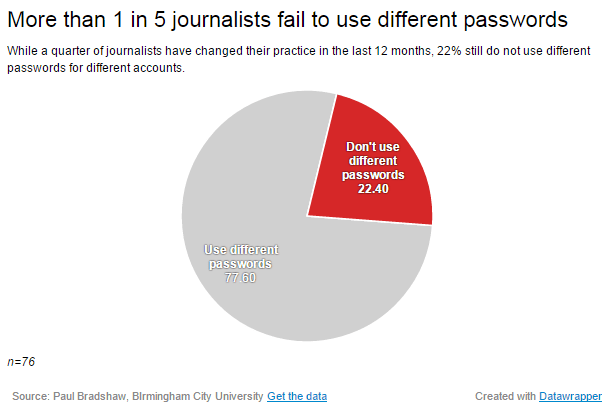
16% of journalists did not do any of the following: use different passwords, clear their browser history, turn off cookies, turn off geolocation or use enhanced privacy settings on social media.
Despite hundreds of journalists and many editors signing Press Gazette’s Save Our Sources petition last year, there is no indication of leadership or communication from the top on the issue of source protection.
Journalists overwhelmingly said that they did not know what their organisation was doing about internet security. But perhaps more importantly, editors did not know either. “I should know the answer to that,” said one, “and it’s worrying that I don’t.”
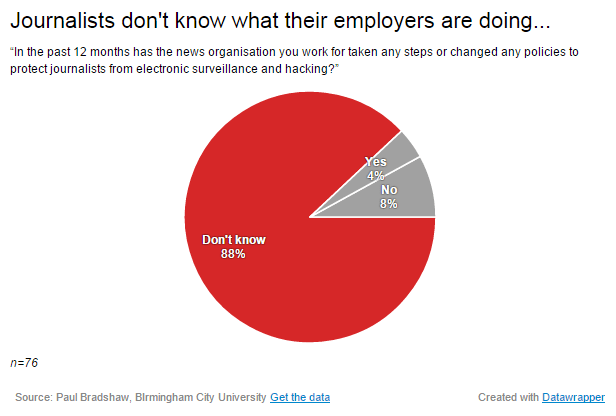
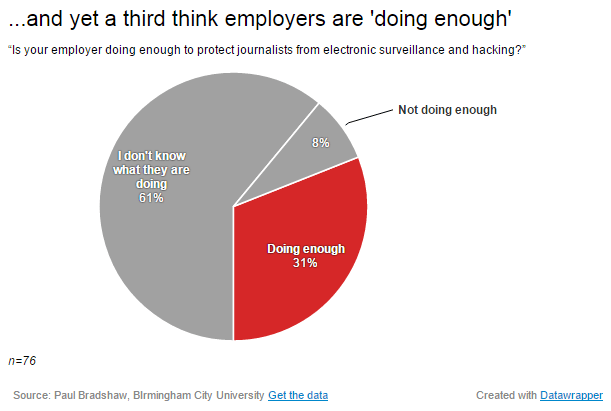
Strangely, even though only 4% of respondents said that their employers had taken steps in the last 12 months on the issue, almost a third of respondents made the leap of faith to say that their employers were “doing enough”.
One thing became very clear: newsrooms and work processes are still set up for an analogue world where protecting sources is a reactive process. Discussions about sensitive sources focus on a potential legal defence if approached directly. No processes are in place to anticipate or prevent sources’ identities being accessed indirectly.
Likewise IT policies focus on protecting email – but there is little consideration to securing social media accounts.
And journalists felt unable to advise sources who were unwilling to talk because of workplace surveillance and contracts with ‘gagging’ clauses.
I’ve organised an event to try to begin to address these issues, with people who have been directly affected, experts on law (including employment law) and people who can advise on the technical side. It’s in Salford at BBC in Media City on Friday November 6 – you can sign up here.

Copyright Football by Banksy, image by Duncan Hull
A recent decision by IPEC (Intellectual Property Enterprise Court) might make journalists, marketers and bloggers think twice before they reproduce images from other people’s websites, reports Cleland Thom.
The presiding judge, Richard Hacon, awarded £6,000 damages against a home improvements company who copied and pasted photos from another site.
The damages were on top of the basic cost of the images, and reflected the fact that the company’s action was ‘flagrant’. Continue reading
The Telegraph’s Laurence Dodds has an unusual claim to fame: he has liveblogged not just one, but four, historical anniversaries: the fall of the Berlin Wall; the funeral of Winston Churchill; the anniversary of Waterloo; and the 75th anniversary of the Battle of Britain.
Anniversary liveblogging is a particularly under-recognised sub-genre which can be enormously successful, and yet there’s very little written about it.
So I asked Laurence what it involved, and what he’s learned from his experiences. Continue reading