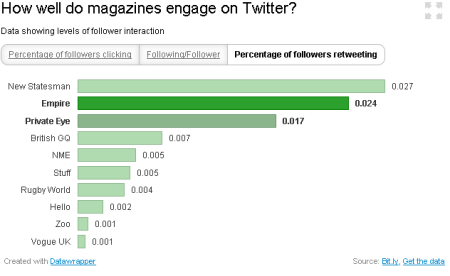
Magazines on Twitter – percentage of followers retweeting – click for interactive version
Magazine Twitter accounts with the highest click-through rates tend to be aimed more directly at the reader and to give the reader a clearly defined reason to engage, according to an analysis by Patrick Scott in the second of a series of three posts.
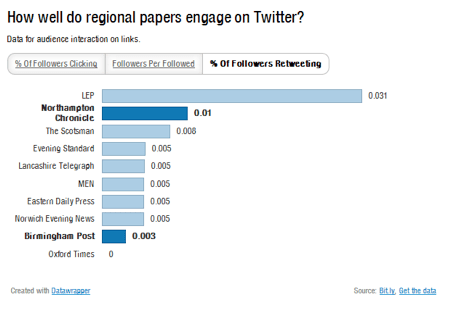
Regional newspapers on Twitter – percentage of followers retweeting – click for interactive version
Newspaper Twitter accounts with the highest click-through rates tend to follow more people, customise tweets for Twitter and engage in more conversation, according to an analysis by Patrick Scott in the first of a series of three posts.
The number of followers a Twitter account has is often assumed to be representative of the influence they command. But is it what we should be measuring? Continue reading →
The Carnival of Journalism is back, and this month is looking at student media. That gives me an excuse to talk about something I seem to find myself ranting every year: “You are not student journalists”.
Even if their course provides no opportunities to do any of these things, they will have Twitter accounts, or Facebook accounts.
All of which means that they are publishers.
Ignorance is bliss?
Describing yourself as a student journalist suggests that you haven’t noticed this.
But worse, it reinforces a similar ignorance in the people you talk to as you go about your business.
These are the press officers that say “We don’t deal with student journalists” and the election officers who stop you at the doors of the count – but also the sources who say “I didn’t realise what I said was going to be published.”
Journalism students need to be honest with the latter and forceful with the former. A large part of that means making a mental shift from ‘this is just an exercise’ to ‘this is a real story with real implications’. In other words that move from ‘I am a student’ to ‘I am a journalist-publisher’.
Not just an exercise
For a start, as a publisher you have to be aware of contempt of court, libel, and copyright. This is not an option – and the number one reason you can never think your work is ‘just an exercise’.
You also have to think about syndication: who you might supply your content to. I encourage my students to work as freelancers, and often put them in touch with different news organisations depending on the story.
So there is no such thing as a student journalist. There are only publishers, and non-publishers. Your story can be seen by a million people, or only one – but you should always prepare for the former. As should the press officers. And your sources.
So change that Twitter biography; that About page. And take your job seriously: because if you don’t, no one else will.
“In my view, if we do not acknowledge the student status of our students (no, that’s not a tautology), we are not being diligent in our duty of care (the pastoral role of all teachers at all levels) to ensure that we “first do no harm”. Yes, we have to, as Paul rightly points out, engage our students in the daily routines and socialisation of newsroom practice and we have to move beyond the newsroom model too; but in doing so, we have to be constantly mindful that our pupils must be kept safe.”
“Student journalists who are not afforded the rights of citizens nor the rights of journalists must be given some protection. Thus, it is important we acknowledge their actions may transcend their status – whatever it may be.”
A new survey for journalists, bloggers and online publishers, which can be found at this link, aims to collect information about their experiences of and views on libel and privacy law
Additionally and separately, recommendations have also been made for Mediation and Early Resolution in defamation disputes.
However, there is very little solid data about the nature and quantity of legal claims made against the media, including small bloggers. Because the majority of libel claims, for example, are believed to be resolved out of court, there is no complete record of disputes.
In short, little is known about bloggers’ and journalists’ actual legal experiences and opinions.
In an effort to build a better picture and to help inform the development of new alternative dispute resolution mechanisms, I am launching a survey as the final part of my doctoral project at the Centre for Law, Justice and Journalism (CLJJ), City University London.
This questionnaire is open to all types of journalists and online writers who expect their readership to be predominantly based in England and/or Wales.
Please take part and share your experiences and encourage your colleagues and friends to participate as well.
All data will be collected anonymously with no identification of organisations or individuals.
This survey is part of Judith Townend’s doctoral project at the Centre for Law, Justice and Journalism (CLJJ), City University London. The research project, which has been given ethical approval by the CLJJ, explores how journalists and online writers are affected by libel and privacy law, as well as other social and legal factors. It will draw attention to the issues faced by online writers and journalists, and help inform the development of resources in this area.
About this questionnaire
The questionnaire is open to all types of journalists and online writers who expect their readership to be predominantly based in England and/or Wales.
It should take between 10 and 30 minutes to complete, depending on your experiences and views. Some questions require an answer so you can be taken to the next relevant question.
All data will be collected anonymously with no identification of organisations or individuals.
The information you have submitted will included in a final report to be published in 2013/14, which may be used for future online and print publications.
Please contact Judith Townend with any questions, or to obtain the final results.
Contact details:
Judith Townend, c/o Peter Aggar, Centre for Law, Justice and Journalism, City University London, Northampton Square, London EC1V 0HB, Tel: +44 (0)20 7040 8167
The Minister giveth, and the Minister taketh away. Last week health secretary Jeremy Hunt ‘banned‘ gagging clauses in NHS contracts – even though they’d already been banned in 1999.
A week later his equivalent in the Ministry of Justice Chris Grayling was issuing a rather less generous directive, gaggingprobation officers from making any comments “in criticism or designed to undermine the justice secretary’s policy or actions”.
And in the police force Operation Elveden ‘crossed a Rubicon‘ as it expanded its scope to include police officers who had leaked information without payment – in other words, speaking to a journalist. (Outside of the operation itself, officers who have spoken to journalists were reported to have found themselves subject to disciplinary investigation, and two suspended.)
More broadly, I am concerned about the ability to have an open public debate when sources feel they cannot express any opinion that is ‘off-message’, and journalists cannot protect their sources.
Doubtless a lack of trust in journalists is a factor, but also the desire for control exercised by PR departments and spin doctors documented by Heather Brooke. I know of one NHS trust, for example, which emailed all employees banning them from commenting publicly on a hospital docusoap.
PR is one thing, but many public sector employees are feeling co-opted into a media management campaign they neither support nor believe to be in the best interests of public health, justice, safety, or service.
The NHS is just the most visible example of how public institutions can confuse their own interest with the public interest. Disciplinary policies can set this out particularly barely. This one from United Lincolnshire Hospitals gives examples of “gross misconduct” that include:
“using social networking sites or similar, where employees in their own time using personal computer equipment can be identified as NHS employees and make comments relating to the Trust or the wider NHS which bring the Trust into disrepute.”
You hear the same conflation of institutional interest with pubic interest in statements from the Ministry of Justice:
“If you associate yourself with London Probation Trust through the publication of details about your role as an employee, or Board member, you must not make or endorse any postings or tweet that may bring LPT, the secretary of state for justice or officials acting on his behalf into disrepute.”
Even retweeting such sentiments from others would, apparently, be taken as “incitement or approval” and lead to possible disciplinary action.
Defenders argue that “There are channels for people to express their views”. Presumably a quiet corner of a blacked-out room. The experiences of health workers and whistleblowers are not promising in this regard.
We are living through the first flushes of a new form of public life where the newfound ability to distribute information is tempered by the growing awareness that anything we say (or the connections we make even in private) may be used against us.
As institutions seek to control their employees’ social expression, journalists will have to work harder to establish trust, to protect sources, and establish private channels of communication. A 1999 West Wing episode saw it coming:
Around this time last year I wrote on this blog about ‘Generation Audioboo’ and the opportunities for anyone entering the field of digital journalism. A year on, there are more free tools, and more editorial choice. Google Hangouts are now ‘On Air’ for all, for example.
Students on the Interactive Journalism MA course at City University London have been setting up their own live events. Yesterday’s group ran a Google Hangout, themed around social media use for journalists. It was live on air; you can view it – and the class discussion below the video – here.
Comparison of time spent on a selection of Live Blogs, articles, and picture galleries at Guardian.co.uk, March to May 2011
In a guest post for OJB, Neil Thurman highlights a new research report that suggests that Live Blogs outperform other online news formats by up to 300% and are seen by readers as more transparent, trusted, and ‘factual’ than conventional online news stories.
Someone, somewhere right now will be writing a thesis, dissertation or journal paper about the very modern moral panic playing out across the UK media.
What began as a story about allegations of sexual abuse by TV and radio celebrity Jimmy Savile turned into a story about that story being covered up, into how the abuse could take place (at the BBC too, in the 1970s, but also in hospitals and schools), then into wider allegations of a paedophile ring involving politicians.
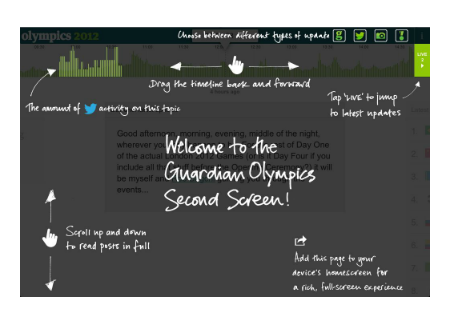
I’ve been using The Guardian’s clever Second Screen webpage-slash-app during much of the Olympics. It is, frankly, a little too clever for its own good, requiring a certain learning curve to understand its full functionality.
But one particular element has really caught my eye: the Twitter activity histogram.
In the diagram below – presented to users before they use Second Screen – this histogram is highlighted in the upper left corner.
What the histogram provides is an instant visual cue to help in hunting down key events.




 Online Journalism Blog