FAQ: What does blogging add to journalism?

Its been a while since I posted a post answering Frequently Asked Questions. This one comes from a student in Holland, whose thesis revolves around the idea that ‘Blogging adds little to journalism

What’s the difference between blogging and traditional journalism?

I’ve answered this and similar questions in a previous FAQ on journalism vs blogging.

What are the pros and cons of blogging compared to other forms of journalism?

That post and other older FAQs probably give some further answers, but a short answer is: blogging provides an extra space to invite people into your journalism and provide opportunities for them to contribute additional information, suggested avenues of inquiry, etc.

It helps build the relationship between journalist and source in a way that standard formats don’t always provide. Continue reading

A review of Help Me Investigate in 2013 – and learning from it in 2014

Help Me Investigate logo

Over on the Help Me Investigate Blog there’s a review of the project’s activities over the past year across its four sites: Health, Olympics, Education and Welfare.

Four site editors landed jobs in the media during the year, which was particularly nice to see, but also meant we lost a certain amount of continuity. Learning from that, this year I’ll be focusing the project’s efforts particularly on welfare issues such as child poverty, housing, food poverty, and the one year anniversary of the bedroom tax.

If you want to get involved, please contact carol@helpmeinvestigate.com or tweet us for a follow on Twitter @carolmiers and @paulbradshaw.

Lyra McKee: why more journalists are going direct to readers

Lyra looked to crowdfunding when writing a book on the murder of the Reverend Robert Bradford

Lyra looked to crowdfunding when writing a book on the murder of the Reverend Robert Bradford

Lyra McKee* is an investigative journalist in Northern Ireland. In this post, originally published on The Muckrakershe explains why she feels journalists are turning away from traditional outlets in favour of building their own brands while exploring crowdfunding and micropublishing.

When I talk to older journalists (older being over the age of 30), they ask me the same question: who do you write for?

It’s an awkward question. If it was 2009, I’d tell them I’d been published in (or had pieces broadcast on) the Belfast Telegraph, Private Eye, BBC, Sky News – a dozen or so news outlets that took my work back then.

In 2013 the answer is: none.

I’m part of a generation of “digital native” journalists who sell their work directly to readers, bypassing traditional news outlets like newspapers and broadcasters. Increasingly, reporters are using services like BeaconKickstarter and Woopie to raise funds directly from their readers and publish their work.

Why are they doing this? Continue reading

Famous Twitter users: who gets the most click-throughs – and why?

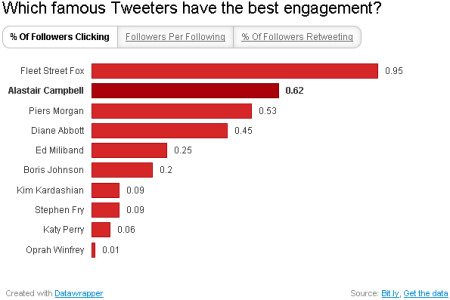
Famous Tweeters - percentage of followers clicking through

Famous Tweeters – percentage of followers clicking through

In the third and final post of this series Patrick Scott had a look at the click-through rate (CTR) of some famous individual Twitter users and found that those who do best tend to be political.

Follow @Patrick_E_Scott

In the first post of this series we saw that regional newspapers that tend to do well on Twitter follow a larger proportion of people relative to the number of people following them.

Conversely, in the second post of the series we saw that this ratio of followers to followed is less significant for magazines. The successful magazine accounts tended to be more personable than personal and gave their followers a clear engagement pathway to go down.

In this post we will see that, like the regional newspapers, famous individuals with a higher CTR tend to have a better followers to followed ratio, although there are a couple of notable exceptions to this. Continue reading

The regional press on Twitter: interview with Johnston Press’s Mark Woodward

In a previous post, we saw that some regional newspapers do a lot better than others in terms of their Twitter click-through rate. Johnston Press titles, The Northampton Chronicle and Echo, The Scotsman and The Lancashire Evening Post tended to perform the best out of the 10 newspapers that we looked at in this regard.

The Online Journalism Blog talked to Mark Woodward, head of websites at Johnston Press, about the findings and about how Johnston Press sees Twitter as a whole.

Johnston Press Logo

Image: Johnston Press

How Johnston Press adapted to Twitter

The need to adapt to the evolving digital landscape is very important for regional newspapers as they attempt to reduce the well documented decline in readership.

A large part of this adaptation is concerned with the growth of social media and the ways that this can be used to drive traffic to a news site.

Out of all the papers analysed in the original post, the Johnston Press titles seemed to be doing this best.

Continue reading

Hyperlocal Voices Revisited: Ray Duffill, Hedon Blog

Ray Duffill originally took part in our Hyperlocal Voices series in November 2010. Still going strong three years later, Damian Radcliffe took the opportunity to see what’s changed during that time in this particular patch of East Yorkshire. (Photo credit: Neil Holmes via Flickr)

1. What’s been the biggest change to the site in the last 3 years?

The Hedon Blog has had an annual facelift and theme change each year of its existence, but the last theme change concentrated on highlighting news content (with more photos and visual impact), rather than being just about listing links to useful information. Continue reading

Magazines on Twitter: who has the most click throughs – and why?

Magazines on Twitter - percentage of followers retweeting

Magazines on Twitter – percentage of followers retweeting – click for interactive version

Magazine Twitter accounts with the highest click-through rates tend to be aimed more directly at the reader and to give the reader a clearly defined reason to engage, according to an analysis by Patrick Scott in the second of a series of three posts.

When analysing the engagement on the Twitter accounts of regional newspapers we saw that one of the key factors was how conversational the newspaper was with its followers. But does this still apply when dealing with national publications? Continue reading

Data journalism ebook now on Amazon’s Kindle Store

Data journalism book Data Journalism Heist

My short ebook Data Journalism Heist is now available on Amazon for Kindle (US link here – also available on other countries’ Amazon sites).

The book is an introduction to data journalism and two simple techniques in particular: finding story leads using pivot tables and advanced filters.

The book also covers useful sources of data, how to follow leads up, and how to tell the resulting story.

You can also buy it from Leanpub, where it’s been live for a couple months now and is available in PDF, mobi and ePub formats. Comments welcome as always.

Hyperlocal Voices: David Williams, MyTown Media

The latest in our series of Hyperlocal Voices sees Damian Radcliffe talk to David Williams, co-founder of MyTown Media Ltd, which runs four hyperlocal websites in Wales.

welshpool

  1. When were the sites launched?

After about six months of fact finding and market research, the first site – MyWelshpool – was launched on Friday 13th, August 2010. Luckily it has been far from a horror story since!

MyNewtown followed in December that year and then MyBrecon and MyRadnor joined the portfolio in 2012.

  1. What made you decide to set up the sites?

I had moved back to the UK after many years in the Middle East and it didn’t take long to realise that the impact of the traditional local media was diminishing, not just in Mid Wales but across the UK.

Newspaper sales were dropping as readers turned to the internet for their news and information. Continue reading